




Bitcoin Correlation With Stocks: S&P 500 & Nasdaq Data


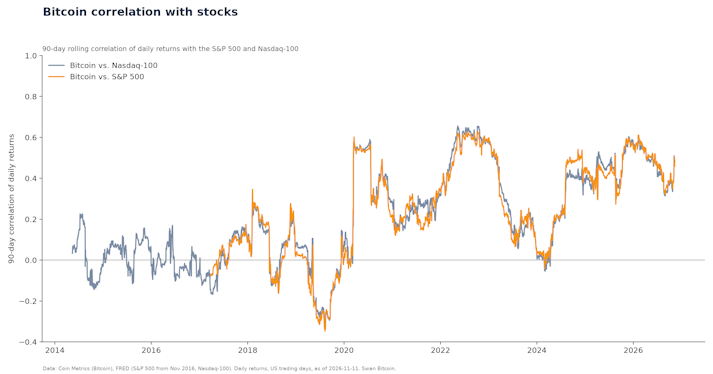
Bitcoin’s correlation with the S&P 500 was 0.42 in 2025 and 0.46 over the last 90 days (Nov 2026). Yearly data since 2017, Nasdaq, dollar and crash days.
In this article
FBTC is the cheaper fund: Fidelity’s Wise Origin Bitcoin Fund charges 0.25% a year, while the Grayscale Bitcoin Trust ETF (GBTC) charges 1.5%, the highest fee of any U.S. spot Bitcoin ETF. Both funds hold real Bitcoin and trade like stocks in a brokerage account. FBTC holds more Bitcoin, about 174,722 BTC against GBTC’s 123,694 BTC, yet GBTC collects more than four times as much in fees. Figures below are as of November 10 and 11, 2026.
TL; DR: FBTC (Fidelity) charges 0.25% a year and held 174,722 BTC on November 10, 2026. GBTC (Grayscale) charges 1.5%, six times as much, and held 123,694 BTC. Both hold real Bitcoin and track its price; the fee is the main difference.
Full name: Fidelity Wise Origin Bitcoin Fund (FBTC) vs. Grayscale Bitcoin Trust ETF (GBTC)
Sponsor fee (expense ratio): FBTC 0.25%; GBTC 1.50%
Bitcoin held (Nov 10, 2026): FBTC 174,722.1 BTC (about $13.0 billion); GBTC 123,693.7 BTC (about $9.2 billion)
Share of all Bitcoin in U.S. ETFs: FBTC 13.8%; GBTC 9.8%
Custodian: FBTC uses Fidelity Digital Assets, Fidelity’s own custodian; GBTC uses Coinbase Custody
Exchange: FBTC trades on Cboe BZX; GBTC trades on NYSE Arca
Started trading as an ETF: both on January 11, 2024. GBTC had existed since 2013 as a private trust and converted that day. FBTC was new.
Fee in dollars per $10,000 a year: FBTC $25; GBTC $150
Holdings come from Bitbo’s U.S. ETF tracker (updated November 10, 2026). Expense ratios come from StockAnalysis and match our full Bitcoin ETF fee comparison.
FBTC, the Fidelity Wise Origin Bitcoin Fund, is a spot Bitcoin ETF from Fidelity Investments. It holds Bitcoin directly, not futures, and its share price follows the price of the Bitcoin it holds, minus its 0.25% yearly fee. Fidelity waived the fee at launch and has charged 0.25% since August 1, 2024.
FBTC is the only U.S. spot Bitcoin ETF that keeps its Bitcoin with its own sponsor’s custodian, Fidelity Digital Assets. Almost every other fund uses Coinbase Custody. With about 174,722 BTC, FBTC is the second-largest U.S. Bitcoin ETF, behind BlackRock’s IBIT.
GBTC, the Grayscale Bitcoin Trust ETF, is the oldest Bitcoin fund in the U.S. It launched in 2013 as a private trust that traded over the counter, often at a large premium or discount to the value of its Bitcoin. It converted to a spot ETF on January 11, 2024, the same day FBTC launched. Since then, creations and redemptions keep its share price close to the value of the Bitcoin it holds.
GBTC kept its 1.5% fee when it converted. Investors have moved out: it held about 619,000 BTC at the conversion and 123,693.7 BTC on November 10, 2026, a drop of about 80%.
GBTC’s fee is six times FBTC’s. Here is what that means for a $10,000 position, assuming a flat Bitcoin price and the fee charged on the remaining balance each year:
FBTC at 0.25%: $25 a year, about $247 over 10 years
GBTC at 1.5%: $150 a year, about $1,403 over 10 years
Measured in Bitcoin, a 0.25% fee takes 250,000 sats a year from every 1 BTC held, or about 0.0247 BTC over 10 years. At 1.5%, it is about 0.14 BTC over 10 years. Our guide to how many sats are in a Bitcoin puts those numbers in context.
What each fund collects (Swan’s calculation, November 2026):
FBTC: 174,722.1 BTC × 0.25% = about 437 BTC a year, or about $32.5 million at $74,418 per Bitcoin
GBTC: 123,693.7 BTC × 1.5% = about 1,855 BTC a year, or about $138 million
GBTC holds 29% less Bitcoin than FBTC but collects about 4.2 times as much in fees.
GBTC charges 1.5% because it kept the fee from its private-trust years when it converted to an ETF. Grayscale’s quarterly report for June 30, 2026 still calculates the sponsor fee as 1.5% of the trust’s assets.
Grayscale’s lower-cost option is the separate Grayscale Bitcoin Mini Trust (ticker BTC), which charges 0.15% and held 62,259.3 BTC on November 10, 2026. It was seeded in 2024 with about 10% of GBTC’s Bitcoin. If you hold GBTC with a gain, moving to a cheaper fund means selling, and selling can trigger capital gains taxes. Get tax advice before you switch.
FBTC and BlackRock’s iShares Bitcoin Trust (IBIT) both charge 0.25%, so on fees they are even. IBIT is much larger, with 793,069 BTC on November 10, 2026, and uses Coinbase Custody; FBTC uses Fidelity’s own custodian. For IBIT against Grayscale, see IBIT vs. GBTC.
FBTC pros:
Low 0.25% fee, tied for the most common fee among U.S. spot Bitcoin ETFs
Holds real Bitcoin, kept with Fidelity’s own custodian rather than Coinbase
Large and liquid, and easy to hold in a brokerage account or IRA
FBTC cons:
You own fund shares, not Bitcoin: you can’t withdraw to your own wallet or send Bitcoin
The 0.25% fee never stops, so it adds up over a long holding period
Trades only during stock market hours
GBTC pros:
Very liquid, with a long track record as the first U.S. Bitcoin fund
Holds real Bitcoin with Coinbase Custody
GBTC cons:
1.5% a year, the highest fee of any U.S. spot Bitcoin ETF
The same limits as any ETF: no withdrawals and no control of the Bitcoin
Switching out of an old, profitable position can trigger taxes
U.S. spot Bitcoin ETFs held 1,263,971 BTC on November 10, 2026, about 6% of Bitcoin’s 21 million supply cap, according to Bitbo. IBIT holds the most, followed by FBTC, then GBTC. On July 29, 2025, the SEC approved in-kind creations and redemptions, letting large traders swap Bitcoin for shares directly; GBTC’s June 2026 report said its agreements did not yet provide for them.
Spot ETFs started trading on January 11, 2024; we covered the launch-day race at the time. Two months later, in March 2024, BlackRock CEO Larry Fink discussed IBIT’s early success on Fox Business. His comments on the Bitcoin ETF begin at the 10-minute, 15-second mark.
For other comparisons, see BITO vs. GBTC (futures vs. spot) and MSTR vs. GBTC.
An ETF charges its fee every year for as long as you hold it. Owning Bitcoin directly has no yearly fee once you hold it, and you can withdraw it to your own wallet. At Swan, buys cost 1% and withdrawals are $0 (see fees). At FBTC’s 0.25%, the yearly ETF fees pass that one-time 1% in about four years. At GBTC’s 1.5%, they pass it in about eight months.
Once you withdraw, a cold storage wallet keeps the Bitcoin under your control. If you want Bitcoin in a retirement account, the Swan Bitcoin IRA holds real Bitcoin rather than ETF shares. For the full case, read why ownership still matters.
Hold your IRA with the most trusted name in Bitcoin.
On cost, FBTC: it charges 0.25% a year against GBTC’s 1.5%. Both hold real Bitcoin and track its price, so for a new position the fee is the main difference. This is not investment advice.
FBTC’s expense ratio is 0.25%, in effect since Fidelity’s launch fee waiver ended on August 1, 2024.
GBTC charges 1.5% a year, six times FBTC’s and IBIT’s 0.25%. Grayscale’s Bitcoin Mini Trust (BTC) charges 0.15%.
On November 10, 2026, FBTC held 174,722.1 BTC and GBTC held 123,693.7 BTC, per Bitbo. GBTC held about 619,000 BTC when it converted to an ETF in January 2024.
FBTC’s Bitcoin is held by Fidelity Digital Assets. GBTC’s is held by Coinbase Custody.
No. You own shares of the fund, not Bitcoin. To hold Bitcoin you can move to your own wallet, you have to buy it directly.
Bitbo: U.S. Bitcoin ETF holdings, updated November 10, 2026
StockAnalysis: FBTC and GBTC expense ratios, checked November 11, 2026
Grayscale Bitcoin Mini Trust information statement (SEC, 2024)
Bitcoin price: $74,418, Coinbase spot price, November 11, 2026
Swan’s calculations: yearly fees in BTC are each fund’s Bitbo holdings times its fee; 10-year costs assume a flat Bitcoin price, with the fee charged on the remaining balance each year.
Drew, a class of 2013 Bitcoiner, is a Research Analyst for Swan Bitcoin.
He has worked in institutional VC/PE, FinTech, and DLT consulting for over six years. He also brings over twelve years of experience working with national nonprofits and start-ups in education and software development in several leadership roles.
In this article
Thoughts on Bitcoin from the Swan team and friends.
Bitcoin’s correlation with the S&P 500 was 0.42 in 2025 and 0.46 over the last 90 days (Nov 2026). Yearly data since 2017, Nasdaq, dollar and crash days.
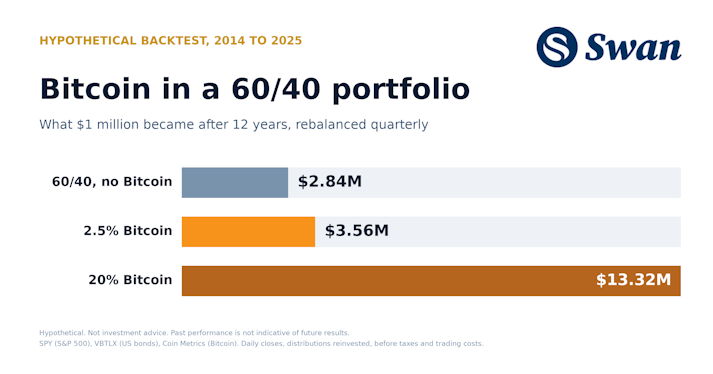
How much Bitcoin to hold in a 60/40 portfolio: 2.5% lifted annual returns from 9.1% to 11.2% (2014–2025). Results from 1% to 20%, drawdowns and method.
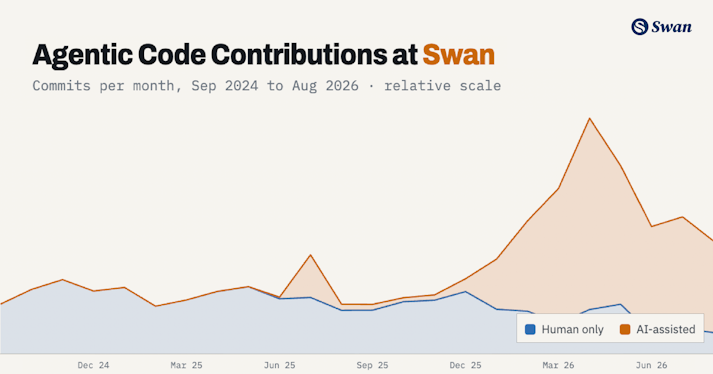
How Swan built an agentic software factory that finds production bugs, reaches consensus on the fix, opens the PR, and proves it works before a human merges.