

Bitcoin Allocation in a 60/40 Portfolio: 12-Year Backtest


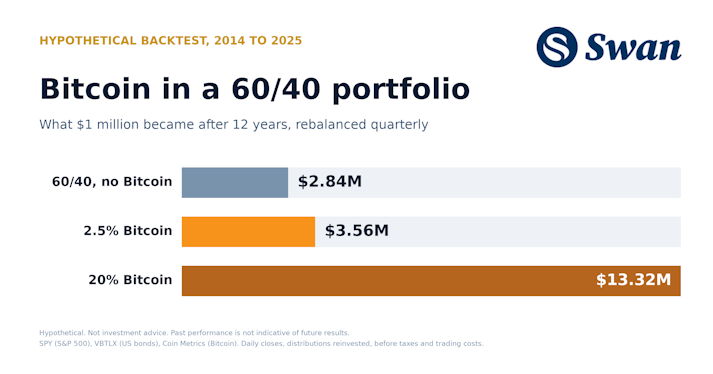
How much Bitcoin to hold in a 60/40 portfolio: 2.5% lifted annual returns from 9.1% to 11.2% (2014–2025). Results from 1% to 20%, drawdowns and method.
How much Bitcoin to hold in a 60/40 portfolio: 2.5% lifted annual returns from 9.1% to 11.2% (2014–2025). Results from 1% to 20%, drawdowns and method.
Managing a substantial Bitcoin position across custody, trusts, retirement accounts, inheritance, and decades of family change is hard. Here is what a serious Bitcoin concierge relationship should solve.
Learn how Bitcoin wealth management works, from custody and security to inheritance planning and liquidity. Discover how families and businesses use Bitcoin to build and protect long-term wealth.
Given the inflationary consequences of war, history advises caution regarding traditional safe-haven assets such as cash and bonds.
With the successful launch of 10 Bitcoin ETFs, Wall Street has come into Bitcoin in a big way, and it will only get bigger. Is this good or bad for Bitcoin? Like many things in life, the answer is nuanced and uncertain.
There are many reasons to criticize DCG and Genesis. Moreover, the drama highlights why holding Bitcoin is a superior option for investors. No fees or if your money benefits a company that doesn’t align with your values.
Unlike other cryptocurrencies, over the long term, Bitcoin has provided exceptional returns, peace of mind, and security for HODLers, their families, businesses, and employees.
Adding Bitcoin to your IRA can provide asset diversification, as well as the potential for higher returns and a measure of protection against monetary debasement.
This drawn-out period of low volatility serves as a coiled spring. The only question is in which direction will the price eventually break.
A new crop of altcoins emerges with each Bitcoin bull cycle. Yet, they inevitably meet the same fate. By illuminating this cyclical trend, we can steer the public away from the risky gamble of altcoins.
Fulfilling its destiny as a hedge against reckless fiscal and monetary policies, Bitcoin has proven its mettle in its first fourteen years of existence. Let’s look at the current debt and inflation predicament.
The best strategy is the one that allows an investor to hold through Bitcoin’s volatility and sleep well at night, whether it’s recurring buys or lump-sum.
Instead of trying to become a trader where you are up against highly capitalized professionals, for most people it is more productive to set up a savings plan to acquire pristine assets with a good risk/reward ratio.
New Bitcoiners are likely upset with the Bitcoin price right now, but we’ve been here before and there are some silver linings.
Bitcoin’s reliability is leading the world on a path towards greater economic stability.
Swan Private Market Update #9 — The markets continued to experience turbulence over the last two weeks as investors grapple with rising risks of inflation, hawkish Fed, economic conditions, and the Russian-Ukraine War.
Heads They Win, Tails You Lose. You’ve been told you should be investing in stocks & bonds — a game full of world-class professionals playing against you. Bitcoin is the fair game, and an easy one to play.
Bitcoin is a brand new technology that differs from anything else that has come before or after it. But where the beginners run into confusion is how Bitcoin differs from other cryptocurrencies.
We’ll all eventually transition to holding zero fiat money, but most people cannot afford to go full Bitcoin just yet.
You should be investing in Bitcoin for its volatility — able to wait out price dips, even to accumulate during them, and celebrate the dramatic price rises when they take place.
We will deliver the industry’s best education team to advisors so that when clients are ready to withdraw Bitcoin to cold storage or engage in collaborative custody, they’ll be armed with the knowledge to do it safely.
Bonds are not as safe today as they are marketed to be. It’s time bond investors begin to protect themselves against the Fed policies that are leading to erosion of the real value of their bond holdings.
It doesn’t matter if you’re a young person starting to invest, a parent saving for their kid’s education or a retiree protecting your nest egg, Bitcoin has a place in everyone’s portfolio.
Whenever someone discovers Bitcoin there are twom phases that typically occur, the first is that wish they could buy it cheaper, and the second is that in hindsight, they should have bought more.
There are different levels of Bitcoin adoption. By segmenting BTC adoption, it becomes easier to see why the wide range of estimates exists but, more importantly, how early adoption of BTC as a preferred store of value.
Lyn Alden compares and contrasts Bitcoin to systems that have Ponzi-like characteristics, to see if the claim that Bitcin is a ponzi holds up.
Through technical development, privacy initiatives, multisignature tools, a savings narrative and more, Bitcoin’s 2020 was super cool.
The best way to approach investing in Bitcoin is regular contributions over time like a 401k.
When companies like Square and MicroStragegy start buying Bitcoin, it’s time to pay attention. But, smaller private companies are also making this move. Here’s why you should consider doing the same.
FBTC charges 0.25% a year and GBTC 1.5%. Compare fees, Bitcoin holdings, custody and 10-year costs of Fidelity’s and Grayscale’s Bitcoin ETFs in 2026.
Bitcoin offers a strategic approach to investing. Here are the top 5 benefits: it reduces volatility risk, simplifies investing, lowers emotional stress, fosters discipline, and enables long-term growth.
BITO holds Bitcoin futures at 0.95% a year; GBTC holds real Bitcoin at 1.5%. Fees, BITO’s dividend, performance and cheaper options as of November 2026.
MSTR is Strategy, holding 850,364 BTC. GBTC is a Bitcoin ETF charging 1.5% a year. How they compare on fees, risk and mNAV, as of November 2026.
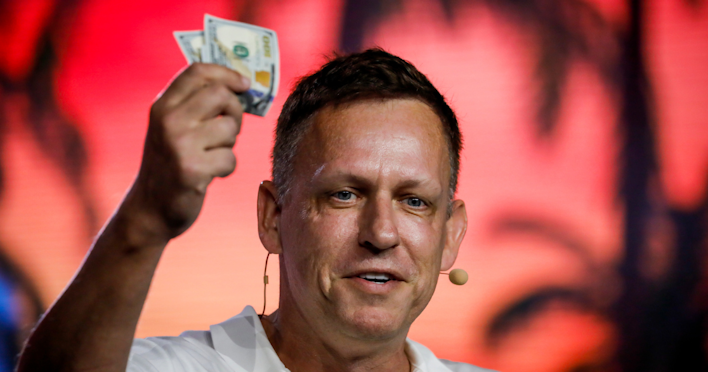
Few stories have captivated the public’s imagination quite like that of Peter Thiel’s Roth IRA. Here is the journey from a modest contribution of $1,700 to +$5 billion, step by step.