
Bitcoin Correlation With Stocks: S&P 500 & Nasdaq Data


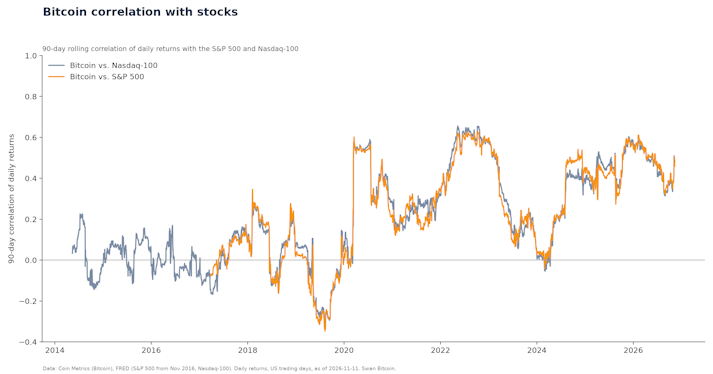
Bitcoin’s correlation with the S&P 500 was 0.42 in 2025 and 0.46 over the last 90 days (Nov 2026). Yearly data since 2017, Nasdaq, dollar and crash days.
In this article
Robinhood charges no commission on stocks, ETFs, Bitcoin or other coins, but it isn’t free. When you buy Bitcoin in the app, Robinhood receives about $0.95 of every $100 through the price you pay (as of June 15, 2026), and moving money costs extra: $100 to transfer your account to another broker, up to 1.75% for instant withdrawals and $5 a month if you subscribe to Robinhood Gold (all checked November 13, 2026).
Below is every Robinhood fee that matters, what each one costs on a real Bitcoin purchase, and the questions people most often ask about them.
Stock and ETF trades: $0 commission. Small regulatory fees apply when you sell.
Bitcoin and other coins, default app orders: no separate fee; Robinhood receives about 0.95% of each buy and each sell through the spread.
Bitcoin and other coins, exchange routing (limit orders, Robinhood Legend, ladders): 0.95% standard / 0.50% reduced under $10K of 30-day volume, down to 0.03% / 0% at $25M+.
Sending Bitcoin to your own wallet: no Robinhood fee; you pay the Bitcoin network fee.
Robinhood Gold: $5 a month or $50 a year, optional, with a one-time 30-day free trial.
Account transfer out (ACATS): $100, for full and partial transfers.
Instant withdrawal to a bank or debit card: up to 1.75% (minimum $1, maximum $150). Standard bank transfers carry no fee on the schedule.
Outgoing wire: $25.
Index options: $0.50 per contract, or $0.35 with Gold, plus exchange and regulatory fees.
Margin interest: 5.25% up to $50K, falling to 4.20% at $50M+.
Staking: Robinhood keeps 25% of rewards on staked coins (staking isn’t offered for Bitcoin).
Paper statements: $2 each, only for accounts worth under $50; electronic statements are free.
About 0.95% for a normal in-app order. When you tap Buy, Robinhood sends the order to a trading firm (a market maker) that fills it slightly above the market price. That gap is the spread, and Robinhood gets a share of it. Robinhood’s own example: on a $100 buy with a 0.96% spread, Robinhood receives $0.95. The same applies when you sell.
You don’t see this as a separate line on your receipt, which is why people search for Robinhood’s “hidden” Bitcoin fee.
You can avoid the spread by switching an order to exchange routing, which sends it to Robinhood’s partner exchanges (EDX Markets and Bitstamp) for a visible percentage fee instead. All limit orders and orders placed in Robinhood Legend or ladders use exchange routing. Market orders always pay the standard fee; a limit order that rests on the order book before it fills pays the reduced fee. Robinhood says the reduced fee is still rolling out and may not be available to every customer yet.
Exchange-routing fees by 30-day exchange-routed volume (standard / reduced):
$0–$10K: 0.95% / 0.50%
$10K–$50K: 0.75% / 0.35%
$50K–$250K: 0.25% / 0.125%
$250K–$500K: 0.15% / 0.075%
$500K–$1M: 0.125% / 0.06%
$1M–$5M: 0.10% / 0.04%
$5M–$10M: 0.04% / 0.02%
$10M–$25M: 0.03% / 0.01%
$25M+: 0.03% / 0.00%
Source: Robinhood Crypto fee schedule (document dated November 2, 2026). Default in-app orders don’t count toward these tiers.
These are the fees each company publishes, applied to a single purchase by a new customer (checked November 13, 2026). “Robinhood app” is a default market-maker order; “Robinhood limit order” is an exchange-routed order in the lowest volume tier.
Buying $100 of Bitcoin
Robinhood app: about $0.95 to Robinhood (about $0.96 total spread in Robinhood’s example)
Robinhood limit order: $0.50 if it rests and fills at the reduced fee, $0.95 if it fills immediately
Swan: $0 for a new client (no buy fee on a new client’s first $250), then $1.00 on later $100 buys
Buying $1,000 of Bitcoin
Robinhood app: about $9.50
Robinhood limit order: $5.00 to $9.50
Swan: $7.50 for a new client (1% on the $750 above the first $250), $10.00 after that
Buying $10,000 of Bitcoin
Robinhood app: about $95
Robinhood limit order: $50 to $95
Swan: $97.50 for a new client, $100 after that
Accumulating $100 a week for a year ($5,200 of dollar-cost averaging)
Robinhood app: about $49.40
Swan: $49.50 for a new client, $52.00 after that
On purchase cost alone, the two are close, and a patient Robinhood limit order is cheaper. The bigger differences come after you buy:
Selling: Robinhood takes about 0.95% again on a default sell. Swan charges 1% on sells.
Moving Bitcoin to your own wallet: no withdrawal fee at either; Robinhood requires a verification step and sets withdrawal limits (details below), while Swan withdrawals are $0 and can run automatically.
Holding: Robinhood charges no holding fee. At Swan, keeping Bitcoin in your own wallet costs $0, and Swan Safe custody costs 0.03% of your balance a month, or $0 with auto-withdrawals.
Retirement: Robinhood IRAs can’t hold Bitcoin. The Swan IRA holds real Bitcoin.
What you can buy: Robinhood offers stocks, options and many coins. Swan sells only Bitcoin.
For a broader look at where to buy, see the most trusted Bitcoin investment sites and our Kraken review.
It’s the ACATS transfer fee: Robinhood charges $100 for each partial or full transfer of your account to another brokerage. Ask the receiving broker whether it reimburses transfer fees.
Two details matter for Bitcoin holders. Fractional shares and coins held with Robinhood Crypto can’t be moved through ACATS. In a full transfer, Robinhood sells your fractional shares and sends the cash, and if you don’t sell your coins within 5 months, Robinhood Crypto sells them and sends the proceeds to the new broker. If you want to keep your Bitcoin rather than have it sold, withdraw it to your own wallet before you transfer.
Going the other way, Robinhood will reimburse up to $75 of another broker’s transfer fee when you move $7,500 or more in stocks, options and cash into Robinhood. That’s the “$75 transfer fee” people ask about.
No, not for a standard account. The only monthly charge is Robinhood Gold, an optional subscription that costs $5 a month or $50 a year after a one-time 30-day free trial.
If you see a $5 charge, you’ve been billed for Gold monthly, every 30 days from the start of your billing cycle. A $50 charge is the annual Gold plan. Gold adds a higher IRA match (3% instead of 1%), lower index options fees, interest on cash and the first $1,000 of margin without interest.
Not hidden, but easy to miss. These are the costs that don’t show as a fee when you trade:
The spread on Bitcoin and other coins: about 0.95% per default buy or sell, built into the price.
Regulatory fees on stock sales: $20.60 per $1 million sold, plus a trading activity fee of $0.000195 per share (maximum $9.79).
Options fees: $0 commission, but $0.04 per contract in options regulatory and clearing fees, and index options cost $0.50 per contract ($0.35 with Gold).
Network fees when you send Bitcoin out, which go to the Bitcoin network, not Robinhood.
The $100 transfer fee and up to 1.75% for instant withdrawals.
Use a standard bank transfer instead of an instant one. The instant option costs up to 1.75% (minimum $1, maximum $150), so pulling out $1,000 instantly can cost up to $17.50. The fee schedule lists no charge for standard bank withdrawals; they just take longer.
Yes. Since a 2024 settlement with the California Department of Justice over earlier withdrawal limits, Robinhood lets customers send Bitcoin to their own wallets. Per Robinhood’s wallet support page (checked November 13, 2026):
Fee: no Robinhood fee; the Bitcoin network fee is estimated and shown before you confirm.
Verification: you must complete a “verify it’s you” step first, which can take up to 5 business days.
Limits: withdrawal limits depend on your verification level and history, and you may qualify for increases.
Allowlisting: if you turn it on, new addresses have a 48-hour wait.
Address types: addresses starting with 1, 3 and bc1q are supported; Lightning and Taproot (bc1p) addresses aren’t.
If you plan to hold for years, a wallet you control removes the platform from the picture. Our guide to the best Bitcoin wallets covers the options, and Swan Vault offers 2-of-3 multisig cold storage with a recovery kit.
No. Robinhood’s fee schedule lists no closing fee, but you have to bring the account to a $0 balance first: no open positions, pending transfers or pending dividends, and Stock Lending and the High Yield Cash Program turned off. Then go to Account, Menu, Settings, Deactivate an account. You either sell your holdings or transfer them to another broker ($100). Withdraw any Bitcoin to your own wallet first if you don’t want it sold.
For stocks and cash in a brokerage account, Robinhood Financial is a member of SIPC, which protects securities customers up to $500,000, including $250,000 for cash claims, if a member firm fails. Bitcoin and other coins are different: Robinhood says coins held through Robinhood Crypto are not FDIC insured or SIPC protected. Robinhood Crypto is licensed by the New York State Department of Financial Services. For how other platforms compare on custody, see is Coinbase safe?
No. Robinhood says products from Robinhood Crypto aren’t available in an IRA. Robinhood IRAs hold stocks and ETFs, and Robinhood adds an IRA match of 1%, or 3% with Gold, on eligible contributions. To hold Bitcoin itself for retirement, compare Bitcoin IRA providers.
For Bitcoin, use a limit order that rests on the book to get the reduced 0.50% fee instead of the 0.95% spread.
Avoid instant withdrawals; standard bank transfers carry no fee.
Before moving to another broker, ask whether it covers the $100 transfer fee.
Withdraw Bitcoin to your own wallet before closing or transferring the account, so it isn’t sold.
Every Robinhood figure on this page comes from Robinhood’s own documents, read on November 13, 2026: the Robinhood Financial fee schedule (document dated November 11, 2026), the Robinhood Crypto fee schedule (dated November 2, 2026) and Robinhood’s support articles, each linked where it’s used. The spread figure is Robinhood’s own, as of June 15, 2026. Swan’s fees come from swanbitcoin.com/fees. Swan sells Bitcoin and competes with Robinhood for Bitcoin buyers; we’ve stuck to each company’s published numbers so you can check them yourself. Fees change, so confirm in the app before you trade.
Hold your IRA with the most trusted name in Bitcoin.
Yes, though not commissions. Bitcoin and other coins carry a spread (Robinhood receives about 0.95%), and there are fees for transferring your account out ($100), instant withdrawals (up to 1.75%), wires ($25) and the optional Gold subscription ($5 a month), as of November 2026.
The ACATS transfer fee, charged on each full or partial transfer of your account to another broker.
That’s Robinhood Gold, billed every 30 days at $5 after the free trial. A $50 charge is the annual Gold plan.
No commission, but Robinhood receives about $0.95 per $100 through the spread on default orders. Exchange-routed orders cost 0% to 0.95% depending on volume and order type.
About $0.95 on $100 and $9.50 on $1,000 with a default in-app order, or $0.50 and $5.00 with a limit order that fills at the reduced fee.
No Robinhood fee, just the Bitcoin network fee, which is shown before you confirm.
Up to 1.75% of the amount, with a $1 minimum and a $150 maximum. Standard bank transfers have no fee.
No commission, but small SEC and FINRA regulatory fees apply to sales.
No closing fee. You must bring the balance to $0 first; transferring holdings out costs $100.
No. Robinhood says Robinhood Crypto products aren’t available in an IRA.
Yes, 3% for accounts opened on or after July 1, 2026, and none for accounts opened before then.
Robinhood Financial fee schedule PDF (document dated Nov 11, 2026; checked Nov 13, 2026)
Robinhood Crypto fee schedule PDF (document dated Nov 2, 2026; checked Nov 13, 2026)
Robinhood crypto order routing ($0.95 per $100 as of June 15, 2026)
Robinhood: transfer your assets out ($100 ACATS; coins not transferable)
Robinhood: transfer your assets in (up to $75 reimbursement)
Robinhood retirement investing (no Robinhood Crypto in IRAs; not FDIC or SIPC)
Drew, a class of 2013 Bitcoiner, is a Research Analyst for Swan Bitcoin.
He has worked in institutional VC/PE, FinTech, and DLT consulting for over six years. He also brings over twelve years of experience working with national nonprofits and start-ups in education and software development in several leadership roles.
In this article
Thoughts on Bitcoin from the Swan team and friends.
Bitcoin’s correlation with the S&P 500 was 0.42 in 2025 and 0.46 over the last 90 days (Nov 2026). Yearly data since 2017, Nasdaq, dollar and crash days.
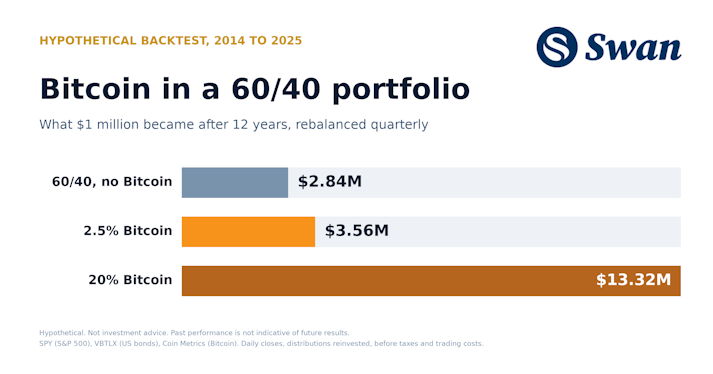
How much Bitcoin to hold in a 60/40 portfolio: 2.5% lifted annual returns from 9.1% to 11.2% (2014–2025). Results from 1% to 20%, drawdowns and method.
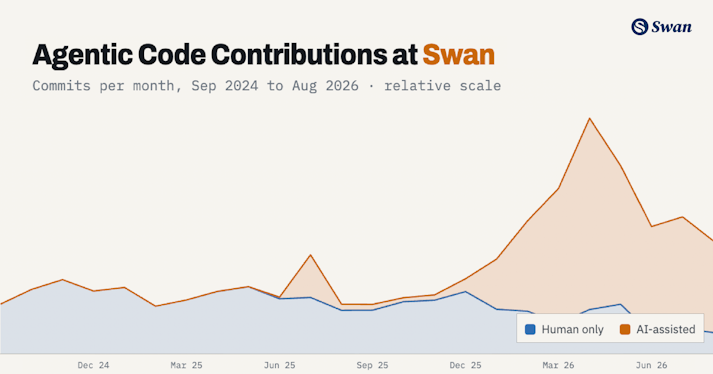
How Swan built an agentic software factory that finds production bugs, reaches consensus on the fix, opens the PR, and proves it works before a human merges.