


Bitcoin Correlation With Stocks: S&P 500 & Nasdaq Data


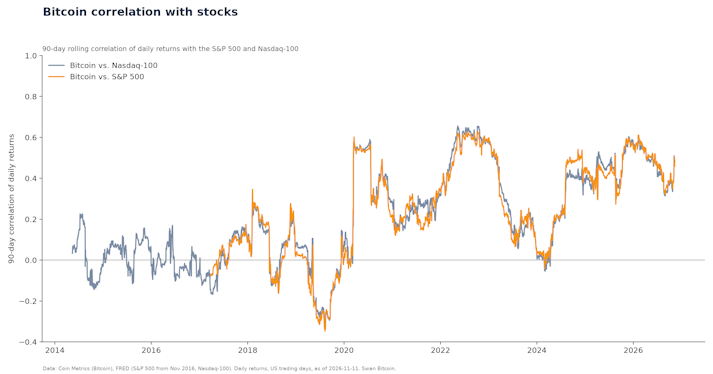
Bitcoin’s correlation with the S&P 500 was 0.42 in 2025 and 0.46 over the last 90 days (Nov 2026). Yearly data since 2017, Nasdaq, dollar and crash days.
In this article
Our verdict: Kraken is a legitimate, regulated exchange that has operated since 2011, publishes regular proof-of-reserves reports and has not reported any hack that took client funds. Kraken Pro is a good fit for active traders. For buying Bitcoin to hold long term, the standard Kraken app is expensive: instant buys cost a 1% fee plus a spread, card purchases add $0.25 plus 3.75%, and many purchases lock withdrawals for 72 hours to 7 days. Kraken isn’t available to residents of Maine or New York. Facts checked November 13, 2026.
Swan sells Bitcoin, so we compete with Kraken. This review uses Kraken’s own fee schedule and support pages, regulator records, Kraken’s financial releases and news reports, each linked and dated below. We did not open a Kraken account for this review; the method is at the end of the page.
Pros
Operating since 2011, with no reported hack of client funds
Licensed or registered with US, EU and UK regulators
Proof of reserves: 103.2% of client Bitcoin held as of September 30, 2026
Low fees on Kraken Pro: 0.40% to 0.80% for new traders, falling with volume
You can withdraw Bitcoin to your own wallet, including over Lightning
Strong account security: passkey two-factor login, a settings lock and no phone-based account recovery
Cons
1% fee plus a spread in the main Kraken app
Card purchases cost $0.25 plus 3.75%, and US clients can only use debit cards
Withdrawal holds of 72 hours to 7 days after card, PayPal, Apple Pay or bank (ACH) purchases
Not available in New York or Maine, with some transfers restricted in Indiana, Louisiana, Massachusetts and Utah
A 3.1 out of 5 Trustpilot score, with 49% of reviews at 1 star
Lists hundreds of coins, which distracts from Bitcoin for long-term savers
Kraken is a US-based crypto exchange and trading platform run by Payward, Inc. It was founded on July 28, 2011, in San Francisco by Jesse Powell, Thanh Luu and Michael Gronager, and is led by co-CEOs Arjun Sethi and Dave Ripley. Kraken lets you buy, sell and hold Bitcoin and hundreds of other coins, and in select US states it also offers stocks, ETFs and futures.
Kraken runs several products:
Kraken app: instant buys and sells for a 1% fee plus a spread
Kraken Pro: an order-book exchange with maker and taker fees from 0.40% and 0.80%
Kraken+: a $4.99 a month subscription that waives app trading fees on up to $10,000 a month
Stocks and ETFs: through Kraken Securities LLC, an SEC-registered broker-dealer
Payward reported 7.1 million funded accounts and $43 billion in average client assets for the third quarter of 2026.
Founded: 2011, San Francisco
Owner: Payward, Inc., a private company. Payward filed confidentially for an IPO in November 2025 and froze the plan in March 2026; CoinDesk reported in September 2026 that it won’t list before Q2 2027 at the earliest.
Size: 7.1 million funded accounts (Q3 2026)
Not available in: Maine and New York
Licenses: FinCEN money services business, a Wyoming bank charter (Kraken Financial), SEC and FINRA for stocks, an EU MiCA license from the Central Bank of Ireland and FCA registration in the UK (Kraken’s license list)
Ratings: Trustpilot 3.1/5 (9,554 reviews), App Store 4.7/5 (36,000 ratings), Google Play 4.2/5 (56,400 reviews), all as of November 13, 2026
Yes. Kraken is a regulated company with licenses in the US, EU and UK. According to Kraken’s license list (updated November 4, 2026):
United States: Payward Interactive, Inc. is registered with FinCEN as a money services business. Kraken Financial is a Wyoming-chartered special purpose depository institution, which made Kraken the first company in its industry to obtain a bank charter. Stocks and ETFs run through Kraken Securities LLC, a broker-dealer registered with the SEC and a member of FINRA and SIPC. US futures run through Kraken Derivatives US, registered with the CFTC.
European Union: Payward Europe Solutions Limited is licensed by the Central Bank of Ireland as a crypto-asset service provider under MiCA.
United Kingdom: Payward Limited is registered with the FCA as a cryptoasset firm.
In May 2026, Payward completed its purchase of Bitnomial, which gave it a CFTC-licensed futures exchange and clearinghouse in the US.
Kraken has one of the stronger safety records among large exchanges, but Bitcoin you leave on any exchange is held by that exchange, not by you.
Strengths
Proof of reserves. An independent accountant checks that Kraken holds at least as much of each covered asset as clients have on deposit. The latest snapshot, dated September 30, 2026, showed a Bitcoin reserve ratio of 103.2%. Clients can check that their own balance was included.
No reported loss of client funds to a hack. The incidents Kraken has disclosed (below) involved Kraken’s own money or limited account data, not client funds.
Profitable, by its own figures. Payward reported $60 million of adjusted EBITDA for Q3 2026, up from $23 million in Q2 and $18 million in Q1. These are company-reported, unaudited figures.
Still expanding. In September 2026, Nasdaq agreed to invest $100 million in Payward. In October 2026, Payward agreed to buy Lithuania’s Saldo Bank, a deal expected to close in 2027 that still needs regulatory approval.
Weaknesses
No government insurance on your Bitcoin. Kraken’s own disclosures warn that clients “may not be protected by government compensation and/or regulatory protection schemes”. Its SIPC membership covers Kraken Securities, its stock brokerage.
Poor customer reviews. Kraken scores 3.1 out of 5 on Trustpilot, and 49% of its 9,554 reviews are 1-star (as of November 13, 2026). Many are about verification, withdrawal holds and slow support.
Exchanges are targets. In February 2025, Bybit lost about $1.5 billion, the largest exchange theft on record. Any Bitcoin left on an exchange carries that risk.
Kraken’s security page lists these protections:
Two-factor authentication with FIDO2 passkeys
No phone or SMS account recovery
A configurable account timeout and a global settings time lock
Email confirmation before a new withdrawal address is added
Encryption of sensitive data at rest and in transit
A mix of cold storage and hot wallets, with cold storage under 24/7 surveillance
A bug bounty program for security researchers
Kraken has had security incidents and regulatory cases, but none of the incidents it has disclosed took client funds.
February 2023: Kraken settled SEC charges over its staking program for $30 million and shut that program for US clients.
November 2023 to March 2025: the SEC sued Kraken for operating as an unregistered exchange. The case was dismissed with prejudice in March 2025.
June 2024: a security researcher found a bug that let accounts be credited with funds that were never deposited. Kraken said the researcher and two associates withdrew nearly $3 million from Kraken’s own treasury. The bug was fixed, and Kraken said no client assets were at risk.
April 2026: Kraken disclosed that two members of its support team had improperly viewed limited data on about 2,000 client accounts, and that a criminal group was trying to extort it with videos of internal systems. Kraken’s security chief said “Our systems were never breached; funds were never at risk” and that Kraken would not pay.
Buying or selling at the current price: Kraken app: 1% plus a variable spread. Kraken says small instant trades carry a fee of up to $2 instead of the 1%. Kraken Pro: 0.80% taker for accounts under $2,500 of 30-day volume.
Limit or target-price orders: Kraken app: 1.5% for custom orders. Kraken Pro: 0.40% maker.
Higher-volume trading (Kraken Pro only): 0.30%/0.60% from $2,500 of 30-day volume; 0.22%/0.38% from $10,000 (or $20,000 held on Kraken); 0%/0.10% from $10 million
Debit card: $0.25 plus 3.75%, plus the spread. US clients can only use debit cards, not credit cards.
Bank deposit (ACH via Plaid): free, $1 minimum, with a 7-day hold before you can withdraw
Bitcoin withdrawal: 0.00002 BTC on-chain, minimum 0.000224 BTC. Lightning withdrawals are also available. Kraken shows the final fee before you confirm.
Kraken+: $4.99 a month or $49.99 a year, with a one-month free trial for new subscribers. It waives the app trading fee on up to $10,000 a month; spreads and card fees still apply.
Fees as of November 13, 2026. Kraken Pro tiers use the better of your 30-day trading volume or the assets you hold on Kraken.
Here is the trading fee on a one-time Bitcoin buy of $100, $1,000 and $10,000 on each route, worked out from the published fee schedules (as of November 13, 2026). Fees are before spreads, which the Kraken app and Kraken+ add on top. Kraken Pro rates are for a new account.
$100 buy: Kraken app $1.00 to $2.00 plus spread (Kraken charges up to $2 on small trades). Kraken Pro $0.80. Kraken+ $0 trading fee, plus $4.99 for the month and the spread. Swan $1.00, or $0 for a new client’s first $250.
$1,000 buy: Kraken app $10.00 plus spread. Kraken Pro $8.00. Kraken+ $0 trading fee, plus the $4.99 subscription and spread. Swan $10.00, or $7.50 for a new client (no fee on the first $250).
$10,000 buy: Kraken app $100.00 plus spread. Kraken Pro $80.00. Kraken+ $0 trading fee (it covers up to $10,000 a month), plus the $4.99 subscription and spread. Swan $100.00, or $97.50 for a new client.
On fees alone, Kraken Pro is the cheapest way to make a one-off purchase on Kraken. Kraken+ only beats the app’s 1% fee once you buy more than about $499 a month there ($4.99 ÷ 1%), and you still pay the spread. Paying by debit card adds $0.25 plus 3.75%, so a $1,000 card purchase in the Kraken app costs about $47.75 in fees before the spread. Sources: Kraken fee schedule, Kraken Pro fees, Kraken+ FAQ, Kraken deposit fees, Swan fees.
The most common reason is a time-based withdrawal hold after you deposit or buy. You can still trade during a hold, and Kraken Support can’t lift it early. Kraken’s support pages list these holds and blocks:
ACH bank deposit (Plaid): 7-day hold on withdrawals equal to the amount deposited, in cash or Bitcoin
PayPal deposit: 7-day hold
Debit card purchase: 72-hour hold on every USD card purchase, not just the first
Apple Pay or Google Pay purchase: up to 72 hours
Password change: withdrawals to new addresses are held for up to 24 hours
Open orders or margin positions: Bitcoin tied up in an open order or used as margin collateral can’t be withdrawn until you cancel or close it
Negative balance: a negative balance in any currency blocks all withdrawals until you cover it
Kraken shows these as “Balance is insufficient for a withdrawal” or as funds “Withheld”. Wire deposits (FedWire) carry no withdrawal hold.
New accounts often hit a weekly limit. US card purchases have a $10 minimum and a 7-day limit between $1,000 and $5,000, depending on account history. ACH limits rise automatically with account activity. Kraken says neither limit can be raised by asking Support.
Yes, in every state except New York and Maine. Some services are limited elsewhere, as of November 4, 2026:
Indiana: no Bitcoin or cash transfers in or out
Louisiana, Massachusetts and Utah: no cash transfers
Staking: available only in a list of states that leaves out California, New Jersey, Texas, Washington and others
Texas: bank deposits through Plaid (ACH) aren’t available
Stocks and ETFs: available in select states
Kraken doesn’t publish a phone number. Use the Kraken Support Center for messaging and help articles; Kraken offers 24/7 live chat and email for urgent issues.
Phone support exists only inside the Kraken mobile apps, as a “Call us” option in the Support tab, and only for some issues. Kraken says any phone number you find online claiming to be Kraken Support “should be treated as a potential phishing scam”, and that its support staff won’t call you without first arranging it by email or chat. If Kraken does call, the app asks you to confirm the call with a one-time code.
3.1 out of 5 from 9,554 reviews, as of November 13, 2026: 33% of reviews are 5-star and 49% are 1-star. Kraken has claimed its profile and replies to 99% of negative reviews. App store ratings are higher: 4.7 on the App Store and 4.2 on Google Play.
Neither is clearly safer; they’re safe in different ways. Coinbase is a public company, so it files audited financial statements with the SEC (Coinbase SEC filings). Kraken is private but publishes proof-of-reserves reports that let clients verify their balances are backed, and it has not reported losing client funds to a hack. Both hold your Bitcoin for you, so for long-term savings the safer step is moving it to a wallet you control. For more on Coinbase, see Is Coinbase safe?
If you’re comparing Kraken with other places to buy Bitcoin, these Swan reviews cover the most common alternatives:
Coinbase: Is Coinbase safe?, Is Coinbase in trouble? and Coinbase alternatives
Robinhood: Robinhood fees, explained
Binance: Is Binance in trouble?
Side-by-side comparisons: the best Bitcoin exchanges and the most trusted Bitcoin investment sites
Fee to buy: Kraken app: 1% plus a spread. Swan: 1%, with no fee on a new client’s first $250.
Recurring buys: Kraken app: yes, at 1%. Swan: yes, it’s the core product (dollar-cost averaging).
Automatic withdrawals to your own wallet: Kraken app: no. Swan: yes, free.
Holding Bitcoin with the company: Swan Safe costs 0.03% of your balance a month, or $0 with automatic withdrawals.
Bitcoin IRA: Kraken: no. Swan: yes (Swan IRA).
Coins offered: Kraken: hundreds. Swan: Bitcoin only.
Fees as of November 13, 2026.
If you trade actively, Kraken Pro is cheaper than most apps. If you’re saving in Bitcoin, a Bitcoin-only service with automatic withdrawals to cold storage you control keeps both costs and risk lower.
Hold your IRA with the most trusted name in Bitcoin.
Yes. Kraken is a regulated exchange founded in 2011. It is registered with FinCEN, holds a Wyoming bank charter through Kraken Financial, and is licensed in the EU under MiCA and registered with the FCA in the UK.
Kraken is licensed to serve US clients in every state except New York and Maine, publishes proof of reserves and has not reported losing client funds to a hack. Bitcoin held on Kraken isn’t protected by government insurance; Kraken’s SIPC membership covers its stock brokerage.
As of November 2026: 1% plus a spread for instant buys in the Kraken app, 1.5% for custom orders, and 0.40% maker or 0.80% taker on Kraken Pro for new accounts. Debit card purchases add $0.25 plus 3.75%.
Yes. A market order on Kraken Pro costs 0.80% for a new account, against 1% plus a spread in the app. Limit orders on Kraken Pro cost 0.40%, against 1.5% for custom orders in the app.
Seven days after an ACH (Plaid) or PayPal deposit, and up to 72 hours after a debit card, Apple Pay or Google Pay purchase. Wire deposits have no hold. Kraken Support can’t shorten a hold.
US card purchases have a 7-day limit between $1,000 and $5,000, set by account history and activity. ACH limits also start low and rise automatically. Kraken says Support can’t raise either limit.
Yes, in the Kraken mobile app, with a Visa or Mastercard debit card for US clients. Apple Pay and Google Pay purchases can trigger a withdrawal hold of up to 72 hours.
No public one. Phone support is only available through the “Call us” option in the Kraken mobile apps for some issues. Kraken says any phone number found online that claims to be Kraken Support is likely a phishing scam.
Yes, except for residents of New York and Maine, as of November 2026. Indiana residents can’t transfer Bitcoin or cash in or out, and Louisiana, Massachusetts and Utah residents can’t make cash transfers.
Not on a public exchange. Kraken’s parent, Payward, is private. It filed confidentially for an IPO in November 2025, paused in March 2026, and CoinDesk reported in September 2026 that a listing won’t come before Q2 2027 at the earliest.
Yes. Kraken+ costs $4.99 a month or $49.99 a year and waives the app trading fee on up to $10,000 of purchases a month. Spreads and card fees still apply.
Swan Bitcoin sells Bitcoin and competes with Kraken for customers who want to buy and save in Bitcoin. To keep this review factual, every fee, limit, license and rating above comes from a public source linked in the text: Kraken’s fee schedules and support articles, Kraken’s license list, Payward’s quarterly releases, Trustpilot and the app stores, regulator records and news reports. We checked each one on November 13, 2026, and we worked out the purchase costs from Kraken’s and Swan’s published fees. We did not open or test a Kraken account for this review. We update it when Kraken changes its fees or terms.
Matt Ruby is a seasoned content writer helping educate million worldwide about Bitcoin for Swan. Matt work with tech companies to create words, videos, and other content that makes them seem human. He specializes in taking boring/drab tech topics and making them interesting, educational, funny, and accessible to regular people.
In this article
Thoughts on Bitcoin from the Swan team and friends.
Bitcoin’s correlation with the S&P 500 was 0.42 in 2025 and 0.46 over the last 90 days (Nov 2026). Yearly data since 2017, Nasdaq, dollar and crash days.
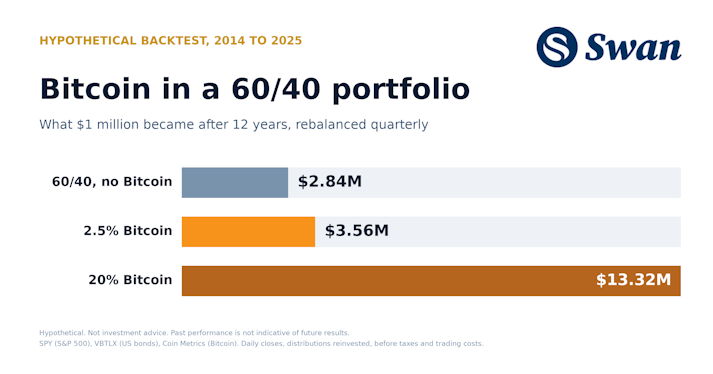
How much Bitcoin to hold in a 60/40 portfolio: 2.5% lifted annual returns from 9.1% to 11.2% (2014–2025). Results from 1% to 20%, drawdowns and method.
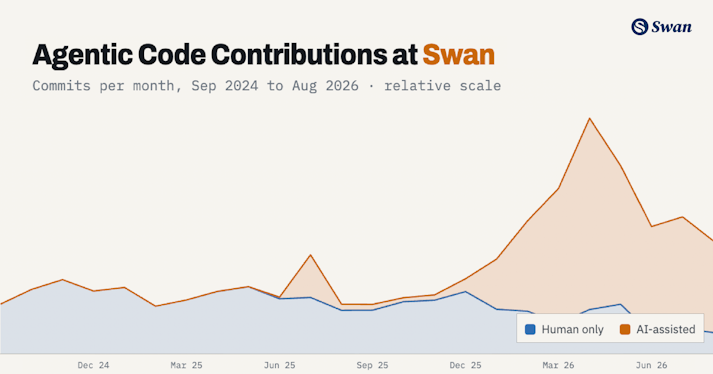
How Swan built an agentic software factory that finds production bugs, reaches consensus on the fix, opens the PR, and proves it works before a human merges.