


Bitcoin Correlation With Stocks: S&P 500 & Nasdaq Data


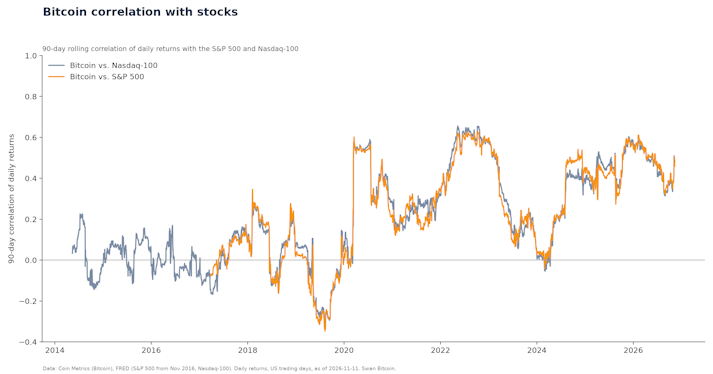
Bitcoin’s correlation with the S&P 500 was 0.42 in 2025 and 0.46 over the last 90 days (Nov 2026). Yearly data since 2017, Nasdaq, dollar and crash days.
In this article
Yes, Coinbase is legit, and as of November 13, 2026 nothing public suggests it’s unsafe to use for buying and trading. It’s a public company in the S&P 500, it reported $718.7 million of net income on $1.22 billion of revenue for the third quarter of 2026, and its annual report says “We hold customer assets one-to-one at all times.” The real risks are around your account, not the company. Coins on Coinbase have no FDIC or SIPC protection, a 2025 insider breach leaked personal data on 69,461 customers, the platform went down for hours on May 7, 2026, and fake “Coinbase withdrawal code” texts are one of the most common scams aimed at its users.
Swan sells Bitcoin and competes with Coinbase. We built this page from Coinbase’s SEC filings, its public status page, court coverage and police alerts, linked in Sources, and checked the figures on November 13, 2026.
For Coinbase’s finances, losses and lawsuits, see Is Coinbase in trouble?
Yes. Coinbase Global is listed on Nasdaq and joined the S&P 500 in May 2025. It files audited results with the SEC every quarter and holds an EU license under the MiCA rules. The SEC’s lawsuit against Coinbase was dismissed on February 27, 2025; the SEC said it dropped the case as part of a policy review, “not on any assessment of the merits.”
Most of Coinbase’s third-quarter 2026 profit came from the rising value of coins it holds as an investment: adjusted net income, which strips out $715 million of those gains, was $78 million.
How Coinbase does on each risk, and what it means for you:
Company failure: Large, regulated and profitable in Q3 2026. For you: Low, but not zero.
Hack of Coinbase’s own wallets: Crime insurance covers a portion of the coins it holds against theft. For you: Low.
Your account getting taken over: Common, and insurance does not cover stolen logins. For you: Your biggest risk. Use a hardware security key.
Leak of your personal data: The 2025 insider breach exposed ID images, addresses and phone numbers, and an October 2026 incident at an analytics vendor exposed contact details for some customers. For you: Medium. Leaked data makes scams more convincing.
Outages and frozen accounts: A multi-hour outage on May 7, 2026, a 50-minute outage on July 14, 2026, and frequent complaints about locked accounts. For you: Medium. You could lose access when you need it.
What happens to your coins in a bankruptcy: Coinbase says customer assets are held for you under UCC Article 8 and are not its property. For you: Better than in 2022, but not tested in court.
Coinbase is fine for money you’re actively trading, but it isn’t a bank account. US dollars held at partner banks can get FDIC pass-through coverage up to $250,000 per depositor, though Coinbase may hold customer cash in US Treasuries or money-market funds instead. Bitcoin and other coins have no FDIC or SIPC protection, and Coinbase’s crime insurance doesn’t cover losses from someone getting into your account. The practical answer: keep only what you’re actively trading on Coinbase, and move long-term savings to a wallet you control.
The most common reasons, in rough order:
A hold on money you just deposited. Cash from a bank transfer can often be used to buy right away but can’t be withdrawn until the transfer clears. Coinbase explains this on its funds on hold page and shows when the balance becomes available.
A restriction on your account. Coinbase can temporarily restrict an account, for example after suspected malicious activity or a problem during account recovery. Completing any identity check it asks for is usually the first step.
A delay on one network. Coinbase’s status page logs delayed sends for individual coins. Bitcoin sends were delayed for about an hour on November 2, 2026.
A delay you turned on. Coinbase’s Transfer Protections, rolled out from June 2026, add time delays and daily limits to outgoing transfers.
A platform outage. During the May 7, 2026 outage, markets were put in cancel-only mode and customers couldn’t transact for several hours.
If someone contacts you offering to “unlock” a withdrawal, it’s a scam. Go to coinbase.com or the app directly.
Yes. A text with a withdrawal or one-time code you didn’t request, plus a phone number to call, is a phishing scam. The Washoe County Sheriff’s Office in Nevada warned about it on May 6, 2025 and quoted a real example: “(COINBASE) The OTP code for your withdrawal is 736191. If this was not you please call us on +1 (877) 338-9228. Ref CB97405.”
How it works: the text makes you think someone is withdrawing your money. When you call, the “support agent” talks you into sharing codes or moving your coins to a “safe wallet” they control.
What to do: don’t reply or call. Don’t share any code. Open the Coinbase app or type coinbase.com yourself to check your account, and report the text as junk.
Why it works so well: the 2025 breach leaked names, phone numbers and balances, so scammers can sound convincing.
On-chain investigator ZachXBT estimated that Coinbase users lose more than $300 million a year to fake “Coinbase support” calls, texts and emails. Coinbase support will never ask you to move your coins to a “safe wallet”, share a recovery phrase or install remote-access software.
Coinbase’s public status page shows how often things go wrong. Our count of its last 50 incidents, from September 19 to November 12, 2026:
50 incidents in 55 days: 18 rated minor, 1 rated major and 31 with no impact rating.
Most were delays on a single network, such as Solana, TON or XRP sends.
The one major incident: coinbase.com was unreachable on the web for about two minutes on October 14, 2026. The app wasn’t affected.
Two involved Bitcoin: delayed receives on October 7 (resolved in 8 minutes) and delayed sends on November 2 (about an hour).
Every update said customer funds were safe.
Two bigger outages in 2026 aren’t in that window:
May 7, 2026: a cooling failure in Amazon Web Services' US-East region took trading offline for several hours; markets ran in cancel-only mode.
July 14, 2026: a configuration change caused a 50-minute outage of trading, deposits, withdrawals and Coinbase Card debit payments. Coinbase said “at no point were user funds at risk.”
The key events behind Coinbase’s safety record, in order:
December 2024: criminals start bribing overseas customer-support contractors to pull customer records (The Register).
February 27, 2025: the SEC dismisses its lawsuit against Coinbase.
May 11 and 15, 2025: Coinbase finds the breach, then discloses it. 69,461 customers are affected.
May 2025: Coinbase joins the S&P 500.
August 2025: the breach class actions are combined into one federal case in New York.
May 7, 2026: an AWS cooling failure causes a multi-hour outage.
June 2026: Coinbase begins rolling out Transfer Protections (time delays, daily limits and trusted-contact approval for outgoing transfers).
July 14, 2026: a configuration change causes a 50-minute outage.
July 22, 2026: Coinbase’s US user agreement is updated; it treats your coins as a “financial asset” held for you.
July 2026: a ruling says the support contractor, TaskUs, must face negligence claims.
October 6–9, 2026: Coinbase says it identified more than 65 active scam victims during a UK and US scam-disruption operation.
October 28, 2026: Coinbase says a security incident at its analytics vendor, Amplitude, exposed contact data for a small subset of customers; it said its own systems weren’t breached and funds weren’t affected.
No funds were taken directly from Coinbase in its biggest recent incident, but customer data was. Starting in December 2024, criminals bribed customer-support contractors overseas to pull customer records. Coinbase found the breach on May 11, 2025, and disclosed it on May 15 (The Register, May 21, 2025).
Customers affected: 69,461.
What leaked: names, dates of birth, addresses, phone numbers, email addresses, the last four digits of Social Security numbers, masked bank details, ID images and account data such as balances and transaction history (BleepingComputer).
What didn’t leak: passwords, seed phrases and private keys. No funds were taken directly from Coinbase.
Response: Coinbase refused a $20 million ransom demand, offered a $20 million reward for information instead, said it would make whole customers who were tricked into sending funds, and estimated its costs at $180 million to $400 million.
Lawsuits: the class actions were combined into one federal case in New York before Judge Edgardo Ramos. In July 2026, a ruling said the support contractor, TaskUs, must face negligence claims. We found no reported settlement as of November 13, 2026. Treat any site offering a “Coinbase breach claim form” with suspicion.
A separate, smaller incident followed in October 2026, when Coinbase said contact data for a small subset of customers was exposed through its analytics vendor, Amplitude. Coinbase didn’t say how many customers were affected.
Bitcoin and other coins: no FDIC or SIPC protection. Coinbase has a crime insurance policy that covers a portion of the coins across its storage systems against theft. It doesn’t cover losses from someone getting into your account. Coinbase says it “will endeavor to make you whole,” but warns losses may exceed its insurance (as of October 19, 2026).
US dollars: cash held at partner banks can get FDIC pass-through coverage up to $250,000 per depositor. But Coinbase may instead invest customer dollars in US Treasuries or money-market funds, and says you shouldn’t assume your cash is held one way or the other. Coinbase held $4.46 billion of customer cash on September 30, 2026.
Usually not, if you sent the coins yourself. A Bitcoin transaction can’t be reversed once it’s confirmed, so coins you send to a scammer are normally gone, and Coinbase’s crime insurance doesn’t cover losses from someone getting into your account.
There are exceptions. After the 2025 breach, Coinbase said it would make whole customers who were tricked into sending funds using the leaked data. If your account was taken over, report it to Coinbase through the app or coinbase.com right away, and file a report with the FBI’s Internet Crime Complaint Center (ic3.gov).
Yes, if you want a US Coinbase account, but only inside the app or on coinbase.com. Like other US brokers, Coinbase must verify your identity, and it reports your sales to the IRS on Form 1099-DA starting with tax year 2025, which requires your taxpayer ID. Coinbase’s identity verification FAQ explains what it asks for.
Never give your Social Security number, ID photos or codes to someone who calls, texts or emails you claiming to be Coinbase. The 2025 breach already leaked the last four digits of some customers' Social Security numbers, which scammers use to sound legitimate.
Coinbase’s 2025 annual report says “When customers use our platform, their assets remain their assets,” and that under UCC Article 8, financial assets it holds for US customers “are not property of Coinbase” and are “not subject to claims of our general creditors.” Its US user agreement (updated July 22, 2026) treats each supported coin in your account as a “financial asset” held for you. That’s a big improvement on 2022, when Coinbase warned customers could be treated as unsecured creditors. It has not been tested in a Coinbase bankruptcy.
You don’t hold the keys. Coinbase controls the Bitcoin in your account, so an outage, a restriction or a court order can stop you from moving it.
Account locks and slow support. These are the most common complaints in its Trustpilot reviews.
Outages at busy moments. Trading went offline for hours on May 7, 2026, and for 50 minutes on July 14, 2026.
Your data is a target. Two data incidents since May 2025, and scam texts that use leaked details.
It’s an exchange for many assets, not a Bitcoin savings tool. If you’re saving in Bitcoin for the long term, self-custody removes most of the risks on this page.
Every exchange holds your coins for you, so the same core risk applies: you depend on the company and on your own account security. Coinbase’s advantages are its US public-company disclosures and its stated one-to-one holding of customer assets. Compare it with our Kraken review and the most trusted Bitcoin investment sites.
Coinbase rates 4.0 out of 5 on Trustpilot from 23,377 reviews (as of November 13, 2026). Reviews are split: 45% are 5-star and 43% are 1-star. Negative reviews mostly mention locked or frozen accounts, slow support and verification delays.
Use a hardware security key (such as a YubiKey) or passkey instead of text-message two-factor codes.
Turn on address allowlisting so withdrawals can only go to addresses you approved.
Turn on Transfer Protections if your account has them. Coinbase began rolling out time delays, daily limits and trusted-contact approval for outgoing transfers in June 2026; it may not be available to every user yet.
Never call a phone number from a text or email. Go to coinbase.com directly.
Keep only what you’re actively trading on Coinbase.
Move long-term savings to a wallet you control, ideally multisig or cold storage.
If you’d rather not keep your savings on Coinbase, compare Coinbase alternatives and the best Bitcoin exchanges. If you’ve decided to leave, here’s how to delete your Coinbase account.
Coinbase is a real, regulated business, and for most people an exchange hack isn’t the biggest danger. The real risks are social: leaked data, impersonation scams and accounts that get frozen. Bitcoin in your own custody can’t be frozen by an exchange. Swan is Bitcoin-only. With Swan Vault, its collaborative 2-of-3 multisig, you hold two keys offline and Swan manages the third for recovery, so you keep control without going it alone.
We read Coinbase’s 2025 annual report and Q3 2026 quarterly report on the SEC’s site, counted incidents on Coinbase’s public status page, and used court coverage, police alerts and news reports for events Coinbase doesn’t publish itself. Coinbase’s own help and legal pages block automated checks, so the insurance and user agreement details are as of October 19, 2026. Figures are as of November 13, 2026 unless dated otherwise.
Hold your IRA with the most trusted name in Bitcoin.
Coinbase is legitimate, regulated and was profitable in Q3 2026. Your biggest risks are account takeovers, scams and outages, not a hack of Coinbase itself. Coins held on Coinbase are not FDIC or SIPC insured.
Yes. It’s a publicly traded US company in the S&P 500, files audited results with the SEC, and is licensed in the EU under MiCA. The SEC dropped its lawsuit against Coinbase on February 27, 2025.
It’s fine for money you’re actively trading. US dollars at partner banks may get FDIC pass-through coverage up to $250,000, but Bitcoin and other coins have no FDIC or SIPC protection. Keep long-term savings in a wallet you control.
Usually because money you just deposited from a bank is on hold until the transfer clears, your account has a security restriction, or a network or platform outage is delaying withdrawals. Check the app for the available date and Coinbase’s status page for outages.
No. An unrequested text with a withdrawal code and a phone number to call is a phishing scam. Don’t call the number or share any code; open the Coinbase app yourself instead.
Usually not if you sent the coins yourself, because Bitcoin transactions can’t be reversed and Coinbase’s insurance doesn’t cover account-level losses. After the 2025 breach, Coinbase said it would make whole customers tricked with the leaked data.
Only inside the Coinbase app or on coinbase.com. US brokers must verify your identity and report sales to the IRS on Form 1099-DA. Never give it to someone who contacts you claiming to be Coinbase.
In May 2025, bribed support contractors leaked personal data on 69,461 customers, including names, addresses, phone numbers and ID images. No passwords, seed phrases or private keys were taken. In October 2026, a vendor incident exposed contact data for a small subset of customers.
US dollar balances held at partner banks may get FDIC pass-through coverage up to $250,000, but Coinbase may also hold customer dollars in Treasuries or money-market funds. Bitcoin and other coins are not FDIC or SIPC insured.
Coinbase says assets it holds for US customers are not its property and not subject to its creditors' claims under UCC Article 8. This hasn’t been tested in a Coinbase bankruptcy.
You don’t hold your own keys, accounts can be locked, support is slow, outages happen at busy moments, and leaked customer data fuels scams.
4.0 out of 5 ('Great') from 23,377 reviews as of November 13, 2026, with 45% 5-star and 43% 1-star reviews.
Coinbase Q3 2026 quarterly report, Form 10-Q (filed Oct 29, 2026)
Q3 2026 results and adjusted net income (Bitcoin.com News, Oct 29, 2026)
SEC dismisses Coinbase case (SEC press release 2025-47, Feb 27, 2025)
Coinbase insurance and protections page (as of Oct 19, 2026)
Coinbase status page and incident history (50 incidents, Sep 19 to Nov 12, 2026)
Coinbase withdrawal code text scam alert (Washoe County Sheriff’s Office, May 6, 2025)
Data breach details and reimbursement (The Register, May 21, 2025)
Breach data types incl. phone numbers (BleepingComputer, May 21, 2025)
Breach lawsuits centralized in SDNY before Judge Ramos (HarrisMartin, Aug 7, 2025)
TaskUs must face negligence claims (Bloomberg Tax/Law, Jul 29, 2026)
Joint Disruption Week, Oct 6–9, 2026 (Ministry of Cyber Affairs, Oct 14, 2026)
Coinbase Transfer Protections (Value The Markets, Jun 16, 2026)
Matt Ruby is a seasoned content writer helping educate million worldwide about Bitcoin for Swan. Matt work with tech companies to create words, videos, and other content that makes them seem human. He specializes in taking boring/drab tech topics and making them interesting, educational, funny, and accessible to regular people.
In this article
Thoughts on Bitcoin from the Swan team and friends.
Bitcoin’s correlation with the S&P 500 was 0.42 in 2025 and 0.46 over the last 90 days (Nov 2026). Yearly data since 2017, Nasdaq, dollar and crash days.
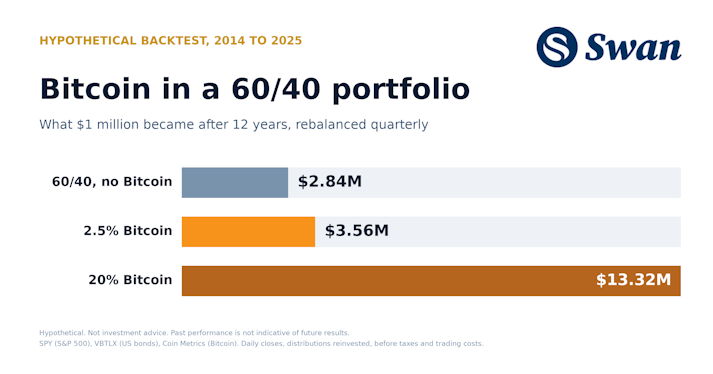
How much Bitcoin to hold in a 60/40 portfolio: 2.5% lifted annual returns from 9.1% to 11.2% (2014–2025). Results from 1% to 20%, drawdowns and method.
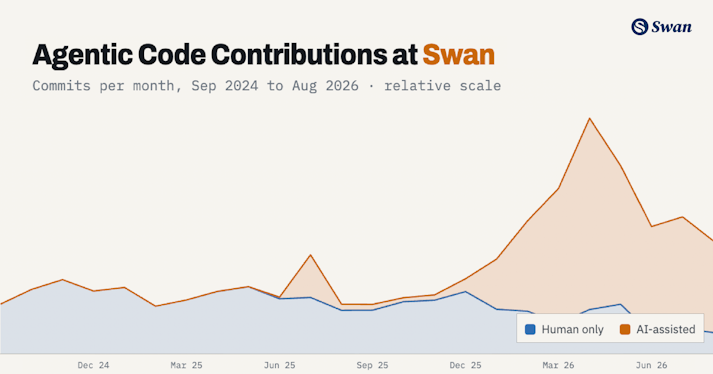
How Swan built an agentic software factory that finds production bugs, reaches consensus on the fix, opens the PR, and proves it works before a human merges.