


Bitcoin Correlation With Stocks: S&P 500 & Nasdaq Data


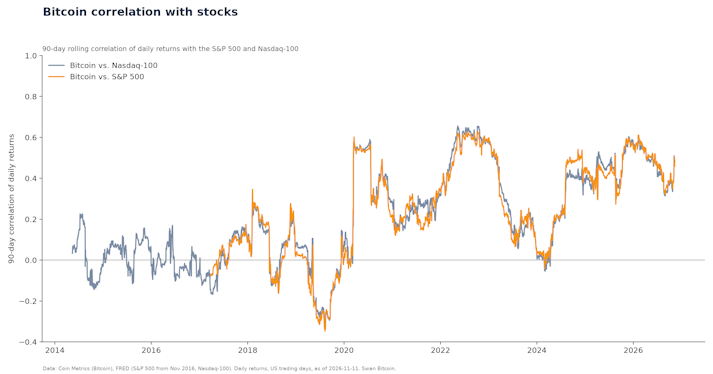
Bitcoin’s correlation with the S&P 500 was 0.42 in 2025 and 0.46 over the last 90 days (Nov 2026). Yearly data since 2017, Nasdaq, dollar and crash days.
In this article
Short answer, as of November 16, 2026: Coinbase’s stock is in trouble, but its finances are not. COIN closed at $127.65 on November 13, 2026, its lowest close since February 2024 and about 67% below its October 2025 peak of $387.27. Yet the company reported $718.7 million of net income on $1.22 billion of revenue for the third quarter of 2026, its 15th straight quarter of positive adjusted EBITDA, and held $8.6 billion in cash and cash equivalents. The weak spot is trading: transaction revenue fell 44% from a year earlier, and almost all of the Q3 profit came from the rising value of coins Coinbase holds as an investment.
Swan sells Bitcoin and competes with Coinbase. We built this page from Coinbase’s SEC filings and dated news reports, linked in Sources, and checked the figures on November 16, 2026. It is not investment advice.
For customers, the bigger questions aren’t about Coinbase’s survival. They’re about who holds your coins, how you’d get them out and what happens if something goes wrong. Our guide to whether Coinbase is safe covers security, insurance and scams in detail.
No public filing or report suggests it. In its Q3 2026 quarterly report, filed October 29, 2026, Coinbase says its $8.8 billion of cash, cash equivalents and marketable investments “will be sufficient in both the short and long term” to meet its cash needs. The same report says Coinbase does not use customer assets as collateral for loans without the customer’s consent and had not seen excessive withdrawals as of September 30, 2026.
Coinbase also had about $2.0 billion left in its share buyback authorization on September 30, 2026.
All figures are from Coinbase’s Q3 2026 earnings presentation, covering July to September 2026 and published October 29, 2026, unless marked otherwise.
Total revenue: $1.22 billion, flat from Q2 and down 35% from Q3 2025
Net income: $718.7 million, after three straight losing quarters
Adjusted net income: $77.7 million, which strips out gains and losses on Coinbase’s investments
Adjusted EBITDA: $332.9 million, up 60% from Q2
Transaction (trading) revenue: $590.2 million, down 44% from $1.05 billion a year earlier
Subscription and services revenue: $570.2 million, 49% of net revenue, including $307 million from the USDC stablecoin
Customer assets on the platform: $377 billion, up from $246 billion at the end of Q2, helped by higher prices and inflows to the ETFs Coinbase holds Bitcoin for
Monthly transacting users: 7.4 million, down from 9.3 million a year earlier (10-Q)
Employees: 4,204 full-time staff, down from 4,988 at the end of Q1 2026, before the May layoffs
Cash and cash equivalents: $8.6 billion
Our breakdown, using the income statement in Coinbase’s Q3 2026 earnings presentation:
$715.0 million of the $718.7 million net income (99.5%) came from gains on Bitcoin and other coins Coinbase holds as an investment, as prices recovered in September.
Without investment gains and losses, Coinbase earned $77.7 million in the quarter (adjusted net income).
First nine months of 2026: a net loss of $34.9 million. Losses of $394.1 million in Q1 and $359.5 million in Q2 almost exactly cancel out Q3's profit.
Trading revenue has fallen four quarters in a row: $1,046 million in Q3 2025, then $983 million, $756 million, $599 million and $590 million.
Subscription and services revenue: $570 million, against the $500 million to $580 million Coinbase forecast in July
Adjusted expenses: $975 million, below the forecast of $980 million to $1,080 million
Transaction expenses: 16.8% of net revenue, against a forecast of “mid-teens”
Q4 2026 so far: about $165 million of transaction revenue from October 1 to October 25, with subscription and services revenue forecast at $550 million to $630 million for the quarter
Because Coinbase’s main business, trading fees, keeps shrinking while Bitcoin trades far below its 2025 record.
Trading revenue fell 44% in a year. Coinbase said price swings in Bitcoin and other coins hit multi-year lows in Q3 2026, and calm markets mean less trading.
Bitcoin is about half its peak. Bitcoin hit a record of about $126,000 on October 6, 2025 and traded around $64,500 on November 16, 2026. For where analysts think it goes next, see our Bitcoin price predictions.
The market looked past the Q3 profit. COIN closed at $160.59 on October 29, the day of the report, and fell 10.6% to $143.54 the next day (Yahoo Finance price history). Investors focused on trading revenue, not the paper gains.
November brought ETF outflows and rate worries. CryptoTicker reported that investors pulled about $1.07 billion out of US spot Bitcoin ETFs from November 9 to 13, citing Farside data, and that futures traders saw a December Federal Reserve rate hike as almost certain. COIN fell 26% from its October 16 close of $173.16 to $127.65 on November 13.
Regulation stalled. The CLARITY Act, a market-structure bill Coinbase lobbied hard for, failed a Senate procedural vote 49–50 on September 15, 2026. Law firm Orrick wrote on October 2, 2026 that passage in this Congress “is now widely viewed as unlikely”. If it doesn’t pass by January 2027, it would generally have to be reintroduced in the next Congress.
It made money in Q3 2026, and adjusted EBITDA has been positive for 15 straight quarters.
It now has a federal trust charter. The OCC gave final approval for Coinbase National Trust Company on November 6, 2026, putting its institutional custody business under a federal regulator. Coinbase has said it won’t take retail deposits.
It is winning market share. Coinbase’s share of global trading volume in Bitcoin and other coins rose to 10.7% in Q3 2026 from 5.6% a year earlier, its fourth straight quarterly gain (Q3 presentation).
Newer businesses are growing. Prediction markets passed $200 million in annualized revenue in Q3 2026. Coinbase also bought the derivatives exchange Deribit for about $2.9 billion in August 2025 and launched no-fee stock trading and Kalshi prediction markets in December 2025.
USDC income continues. Its revenue-sharing deal with Circle, which issues USDC, renewed automatically through 2029 under existing conditions (reported August 2026). Average USDC held in Coinbase products hit a record $22 billion in Q3 2026.
The SEC dropped its lawsuit. The SEC dismissed its 2023 case against Coinbase on February 27, 2025, with prejudice, so it can’t be refiled. Coinbase also has an EU license under the MiCA rules and has been in the S&P 500 since May 2025.
Regulator inquiries. Coinbase’s Q3 2026 report says it has received investigative subpoenas and requests from state agencies, attorneys general and other regulators, covering topics such as how it lists assets, its staking programs and its stablecoin products. It says it intends to cooperate and doesn’t name any investigation it expects to have a material effect.
The May 2025 data breach. Criminals bribed overseas customer-support contractors to steal data on 69,461 customers, including names, addresses, phone numbers, ID images and balances, but no passwords or private keys. Coinbase estimated the cost at $180 million to $400 million. The lawsuits were combined into one federal case in New York, and in July 2026 a ruling said the contractor, TaskUs, must face negligence claims. No settlement had been reported as of November 16, 2026.
The Underwood class action. Filed in 2021 in federal court in New York, it claims Coinbase sold unregistered securities. On July 30, 2026, the court ruled for Coinbase on the claims covering most of the transactions at issue; the rest of the case continues (Q3 2026 10-Q).
Oregon’s lawsuit. Oregon’s attorney general sued in 2025, claiming Coinbase sold unregistered securities. Coinbase moved the case to federal court, and in September 2025 a magistrate judge recommended sending it back to state court. The federal case is stayed until March 16, 2027, with no ruling on that recommendation (docket checked November 16, 2026).
State staking orders. In 2023, California, New Jersey, South Carolina and Wisconsin, and later Maryland, ordered Coinbase to stop taking new staking deposits from residents. South Carolina dropped its case in 2025. On October 29, 2026, New Jersey told Coinbase it intends to rescind its order, according to the Q3 2026 10-Q. As of October 2025, staking was still unavailable to residents of California, New Jersey, Maryland and Wisconsin.
Ireland’s fine. The Central Bank of Ireland fined Coinbase Europe €21.5 million (about $24.7 million) on November 6, 2025, after faults in its monitoring system left more than 30 million transactions unchecked for money laundering for 12 months.
Taiwan. On October 15, 2026, a news report citing Bloomberg said Taiwan blocked the Coinbase and Kalshi websites over suspected betting on its November 28, 2026 local elections. Taiwan’s Criminal Investigation Bureau requested the block and the New Taipei District Court approved it (Bitcoin.com News, October 16, 2026). No end date had been reported as of November 16, 2026.
Impersonation scams. Blockchain investigator ZachXBT estimated in early 2025 that Coinbase users lose more than $300 million a year to scammers posing as Coinbase support. The leaked breach data made these scams easier.
Yes, two notable ones. On May 7, 2026, a cooling failure at an Amazon Web Services data center took trading offline for several hours. On July 14, 2026, a configuration change caused a 50-minute outage of trading, deposits, withdrawals and card payments; Coinbase said user funds were never at risk. Coinbase’s public status page logs smaller incidents, such as delayed sends on a single network.
Coinbase
The key events behind the numbers, in order (sources are linked in the sections above):
February 2025: The SEC dismisses its 2023 lawsuit with prejudice.
May 2025: Coinbase discloses an insider data breach affecting 69,461 customers and joins the S&P 500.
June 2025: Coinbase receives an EU license under MiCA.
August 2025: Coinbase completes its roughly $2.9 billion purchase of Deribit.
October 2025: Bitcoin hits a record of about $126,000 on October 6, and COIN peaks at $387.27 on October 8.
November 2025: Ireland’s central bank fines Coinbase Europe €21.5 million.
December 2025: No-fee stock trading and Kalshi prediction markets launch.
February 2026: Bitcoin falls to $63,000 on February 5. Coinbase reports a $666.7 million net loss for Q4 2025.
April 2026: The OCC conditionally approves a national trust charter.
May 2026: Coinbase lays off about 14% of staff on May 5, and an AWS failure halts trading for hours on May 7.
July 2026: A 50-minute outage on July 14; a court rules for Coinbase on most claims in the Underwood case on July 30.
August 2026: The USDC revenue deal with Circle renews through 2029.
September 2026: The CLARITY Act fails a Senate procedural vote, 49–50, on September 15.
October 2026: Taiwan blocks Coinbase’s website on October 15. Coinbase reports a $718.7 million Q3 profit on October 29, and COIN falls 10.6% the next day.
November 2026: The OCC gives final approval for Coinbase’s trust charter on November 6. COIN closes at $127.65 on November 13, its lowest close since February 2024.
Your Bitcoin is not FDIC or SIPC insured. Coinbase’s crime insurance covers a portion of the coins across its storage systems against theft. It does not cover your losses if someone gets into your account (as of October 19, 2026).
Your coins should stay yours in a bankruptcy. In 2022 Coinbase warned that customers could be treated as unsecured creditors if it went bankrupt. Its current user agreement (updated July 22, 2026) says Bitcoin and other coins in your Coinbase account are treated as a “financial asset” under Division 8 of the California Uniform Commercial Code. That rule is meant to keep them separate from Coinbase’s own assets. It’s much better than 2022, but it hasn’t been tested in a Coinbase bankruptcy.
Coinbase holds a lot of the world’s Bitcoin. It held about 3.0 million Bitcoin for customers, worth $252 billion, on September 30, 2026 (Q3 2026 10-Q). CEO Brian Armstrong said in February 2026 that Coinbase has “80% plus” of US Bitcoin ETF custody, so ETF holders depend on it too; see what those funds charge in our Bitcoin ETF fees guide. That’s a lot of Bitcoin with one custodian.
For Coinbase’s security record, insurance and scams, read our guide to whether Coinbase is safe. For the same questions about another big exchange, see Is Binance in trouble?
Swan is Bitcoin-only, so we look at this differently from a multi-coin exchange. Coinbase is a large, regulated public company and isn’t about to disappear. Its struggles still show the trade-off of leaving savings on any exchange: you depend on its finances, its security and its support staff. The surest protection is to hold your own keys.
Set up a Bitcoin wallet you control, such as a hardware wallet or a multisig vault, and write down the recovery phrase offline.
In Coinbase, choose Send, paste your wallet’s Bitcoin address and send a small test amount first.
Once the test arrives, send the rest.
If you keep an account open, turn on Coinbase’s address allowlisting and use a hardware security key.
If you’re closing your account completely, follow our step-by-step guide to deleting your Coinbase account.
If you want to keep buying Bitcoin somewhere else, compare fees, custody and IRA options in our guide to trusted Bitcoin investment sites, see our roundup of Coinbase alternatives or read our Kraken review.
Hold your IRA with the most trusted name in Bitcoin.
No public evidence says so. Coinbase reported $718.7 million of net income in Q3 2026, held $8.6 billion in cash and cash equivalents, and says its cash and investments are sufficient for its short- and long-term needs (Q3 2026 10-Q, filed October 29, 2026).
Trading revenue fell 44% from a year earlier in Q3 2026, Bitcoin trades about 49% below its October 2025 record, and November brought ETF outflows and rate worries. COIN closed at $127.65 on November 13, 2026, its lowest close since February 2024.
Yes. Net income was $718.7 million, but $715.0 million of it came from gains on the coins Coinbase holds as an investment. Adjusted net income, which strips those out, was $77.7 million.
Yes, in the fourth quarter of 2025. Coinbase reported a net loss of $666.7 million, driven by a $718.2 million drop in the value of the coins it holds as an investment. It then lost $394.1 million in Q1 2026 and $359.5 million in Q2 2026 before returning to profit in Q3.
Coinbase cut about 14% of staff on May 5, 2026. It had 4,204 full-time employees on September 30, 2026, and no new layoffs had been reported as of November 16, 2026.
Coinbase says it receives investigative subpoenas and requests from state agencies, attorneys general and other regulators, including about asset listings, staking and stablecoin products. The SEC’s main lawsuit was dismissed in February 2025. Oregon’s lawsuit is paused until March 2027.
Yes. The 2025 data breach lawsuits are combined in one federal case in New York, and the Underwood securities case continues on a smaller set of claims after a July 30, 2026 ruling for Coinbase on most of them.
Coinbase’s user agreement (updated July 22, 2026) treats Bitcoin and other coins in your Coinbase account as financial assets held for you, separate from Coinbase’s own assets. This hasn’t been tested in a Coinbase bankruptcy. Coins held at Coinbase are not FDIC or SIPC insured.
Yes. It was dismissed with prejudice on February 27, 2025.
Set up a wallet you control, send a small test amount from Coinbase with Send, then send the rest once it arrives.
Coinbase Q3 2026 earnings presentation (SEC Form 8-K exhibit, Oct 29, 2026)
Coinbase Q3 2026 quarterly report, Form 10-Q (filed Oct 29, 2026)
COIN closes at $127.65, lowest since February 2024 (CryptoTicker, Nov 15, 2026)
Bitcoin fell to $63,000 from its $126,210 peak (LIGA.net, Feb 6, 2026)
OCC final approval for Coinbase National Trust Company (Decrypt, Nov 9, 2026)
Senate fails to advance the CLARITY Act (DLA Piper, Sep 22, 2026)
SEC dismisses Coinbase case (SEC press release 2025-47, Feb 27, 2025)
Circle–Coinbase USDC deal renewed through 2029 (CoinTurk, Aug 6, 2026)
USDC deal renews under existing conditions (BrokerChooser, Aug 4, 2026)
Stock trading and Kalshi prediction markets (Fortune, Dec 17, 2025)
Breach lawsuits centralized in SDNY before Judge Ramos (HarrisMartin, Aug 7, 2025)
TaskUs must face negligence claims (Bloomberg Tax, Jul 29, 2026)
Oregon v. Coinbase stayed until March 16, 2027 (PacerMonitor docket, checked Nov 16, 2026)
Four states halt new Coinbase staking (The Block, Jul 14, 2023)
South Carolina drops its staking case (The Block, Apr 1, 2025)
Staking still limited in California, New Jersey, Maryland and Wisconsin (Decrypt, Oct 8, 2025)
Central Bank of Ireland fines Coinbase Europe (The Block, Nov 6, 2025)
Taiwan blocks Coinbase and Kalshi sites (MT Newswires via MarketScreener, Oct 15, 2026)
Taiwan court-ordered block, CIB request (Bitcoin.com News, Oct 16, 2026)
Matt Ruby is a seasoned content writer helping educate million worldwide about Bitcoin for Swan. Matt work with tech companies to create words, videos, and other content that makes them seem human. He specializes in taking boring/drab tech topics and making them interesting, educational, funny, and accessible to regular people.
Drew, a class of 2013 Bitcoiner, is a Research Analyst for Swan Bitcoin.
He has worked in institutional VC/PE, FinTech, and DLT consulting for over six years. He also brings over twelve years of experience working with national nonprofits and start-ups in education and software development in several leadership roles.
In this article
Thoughts on Bitcoin from the Swan team and friends.
Bitcoin’s correlation with the S&P 500 was 0.42 in 2025 and 0.46 over the last 90 days (Nov 2026). Yearly data since 2017, Nasdaq, dollar and crash days.
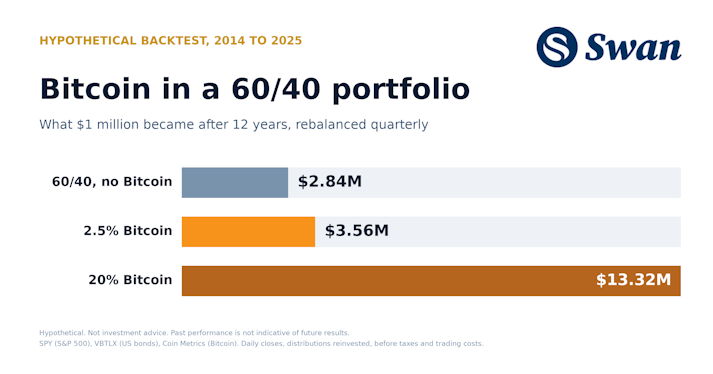
How much Bitcoin to hold in a 60/40 portfolio: 2.5% lifted annual returns from 9.1% to 11.2% (2014–2025). Results from 1% to 20%, drawdowns and method.
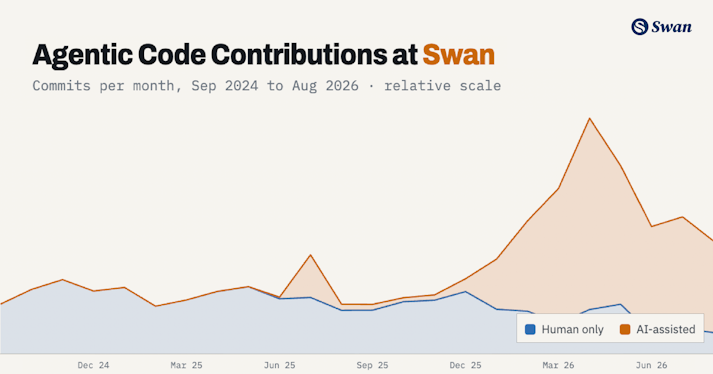
How Swan built an agentic software factory that finds production bugs, reaches consensus on the fix, opens the PR, and proves it works before a human merges.