

Swan Bitcoin IRA
Bitcoin is the ultimate asset for your retirement. Create a tax shelter for exponential returns! Get started in less than 2 minutes. Book a call with one of our Bitcoin IRA specialists today!
In this article
The most trusted places to buy Bitcoin in 2026 are regulated, Bitcoin-focused services that let you withdraw to your own wallet, such as Swan, River and Strike. Large brokers like Fidelity and Cash App are also solid choices. If you only want a fund that tracks the price, the spot Bitcoin ETFs IBIT and FBTC charge 0.25% a year (iShares, as of Oct 16, 2026; StockAnalysis, as of Oct 19, 2026). What matters most is not the brand but four things: regulation, custody, the ability to withdraw, and a long track record.
Disclosure: Swan is one of the companies compared below. We’ve used each company’s published fees and treated them the same way.
Bitcoin is the ultimate asset for your retirement. Create a tax shelter for exponential returns! Get started in less than 2 minutes. Book a call with one of our Bitcoin IRA specialists today!
Swan: Bitcoin only. Fee to buy: 1% (no buy fee on a new client’s first $250). Recurring buys: yes. Withdraw to your own wallet: free, can be automatic. Bitcoin IRA: yes.
River: Bitcoin only. Fee to buy: 1% per order up to $1 million, falling to 0.25% on orders over $15 million; a spread may apply. Recurring buys: free starting seven days after you set it up. Withdraw to your own wallet: yes, including Lightning. Bitcoin IRA: no in-house IRA.
Strike: Bitcoin only. Fee to buy: 0.89% on up to $4,999.99 a month, falling to 0.25% at $15 million and up, plus a target spread of 0.22%. Recurring buys: free after the first week. Withdraw to your own wallet: yes, on-chain and Lightning. Bitcoin IRA: no, per a competitor’s comparison (Unchained, May 2026).
Cash App: Bitcoin only (plus stocks). Fee to buy: 2% under $500, falling to 0% at $2,000 and up, plus a 0–0.75% spread. Recurring buys: Auto Invest, free with no spread. Withdraw to your own wallet: yes, free at standard speed. Bitcoin IRA: no.
Fidelity: Bitcoin and a few other coins. Fee to buy: 1%. Recurring buys: no. Withdraw to your own wallet: yes, being rolled out gradually; network fee applies. Bitcoin IRA: yes, a Fidelity Crypto IRA (transfers out not allowed).
Spot ETFs (GBTC, IBIT, FBTC): funds that track the Bitcoin price. Fee: range between 0.25% to 1.5% a year, plus brokerage costs. Recurring buys: through a broker. Withdraw to your own wallet: no; you own fund shares, not Bitcoin. Bitcoin IRA: yes, in any IRA.
Sources: Fees from each company’s own pages, checked October 19, 2026: Swan, River (updated Aug 6, 2026), Strike, Cash App, Fidelity. Withdrawal details: River, Strike, Fidelity and Fidelity.
Swan also offers optional custody plans, from free self-custody to Swan Vault at $30 a month up to $150,000, then 0.02% a month, capped at $500 (Swan fees, as of Oct 19, 2026). Fidelity switched from a built-in spread to a separate 1% fee for trades from December 4, 2025 (Fidelity).
All three are Bitcoin-only. Here is how they differ, using the same published fees as above:
Fee to buy: Swan charges 1%, with no buy fee on a new client’s first $250. River charges 1% per order up to $1 million. Strike charges 0.89% on up to $4,999.99 a month, plus a target spread of 0.22%.
Recurring buys: all three offer them.
Withdrawals to your own wallet: Swan’s are free and can run automatically. River and Strike both support on-chain and Lightning withdrawals.
Bitcoin IRA: Swan offers a Bitcoin IRA with a 1% fee on buys and sells. River and Strike have no in-house IRA.
It’s regulated where you live. In the US, look for state money-transmitter licenses, a trust charter, or a custodial relationship that has these licenses.
You can withdraw to your own wallet. A site that won’t let you take your Bitcoin out is a red flag. Robinhood paid a $3.9 million settlement in California in 2024, partly over blocking customers from withdrawing their coins from 2018 to 2022 (California AG, as of Sept 4, 2024).
It’s clear about custody. You should know who holds your Bitcoin, whether it’s kept separate from the company’s money, and whether it’s ever lent out.
It focuses on Bitcoin. Bitcoin-only companies don’t list hundreds of other coins or run risky lending schemes. Exchanges that list everything have more ways to fail. Bybit lost about $1.5 billion in a February 2025 hack the FBI attributed to North Korea (BleepingComputer, as of Feb 27, 2025). In September 2026, Bitget reported about $351.6 million in unauthorized transfers from some of its wallets and paused withdrawals; it said its user protection fund covers the loss (Bloomberg Government, as of Sept 25, 2026).
It’s been around. Look for a track record through at least one bear market, such as 2022.
Its fees are clear. A fee shown up front is easier to compare than a hidden spread.
The checklist above comes from real failures. Here they are in order, each with its source:
June 12, 2022: Celsius paused withdrawals and transfers on its platform, citing market conditions (The Block, June 12, 2022).
November 11, 2022: FTX began Chapter 11 bankruptcy proceedings after a wave of withdrawals (Al Jazeera, Nov 11, 2022). Read our analysis of the FTX collapse.
2018 to 2022: Robinhood blocked customers from withdrawing their coins, part of what led to a $3.9 million settlement with California in 2024 (California AG).
February 2025: Bybit lost about $1.5 billion in a hack the FBI attributed to North Korea (BleepingComputer).
September 2026: Bitget reported about $351.6 million in unauthorized transfers and paused withdrawals (Bloomberg Government).
Each event hit funds held on the platform. That’s why the ability to withdraw to a wallet you control, ideally automatically, is the first thing to check.
Bitcoin-only companies sell one asset with a fixed supply and no issuer. Multi-coin exchanges make more money from trading activity, which means more incentive to list new coins and push trading. For long-term savers, a Bitcoin-only service with automatic withdrawals to self-custody removes most of the risks that sank companies like FTX and Celsius in 2022. For more on how exchanges compare, see our Bitcoin exchanges guide, our Kraken review and how exchange listings work against holders.
Buying a fixed dollar amount on a schedule, known as dollar-cost averaging, removes the need to time the market. It is also the cheapest way to buy on several of these services: River’s and Strike’s recurring buys are free after the first week, and Cash App’s Auto Invest has no fee and no spread. Swan pairs recurring buys, a disciplined way to accumulate Bitcoin, with free automatic withdrawals to your own wallet. For how scheduled buying compares with investing all at once, see recurring buys vs. lump-sum investing.
Choose an ETF if you want Bitcoin in an existing brokerage or 401(k) and don’t need to hold or move actual coins. US spot Bitcoin ETFs held about $109 billion in early October 2026 (Cointelegraph, citing SoSoValue, as of Oct 2, 2026). IBIT alone held about $65 billion (iShares, as of Oct 16, 2026). See how the biggest funds compare in IBIT vs. GBTC.
Choose real Bitcoin if you want to hold your own keys (how cold storage works), avoid yearly fund fees, and own an asset no company can freeze.
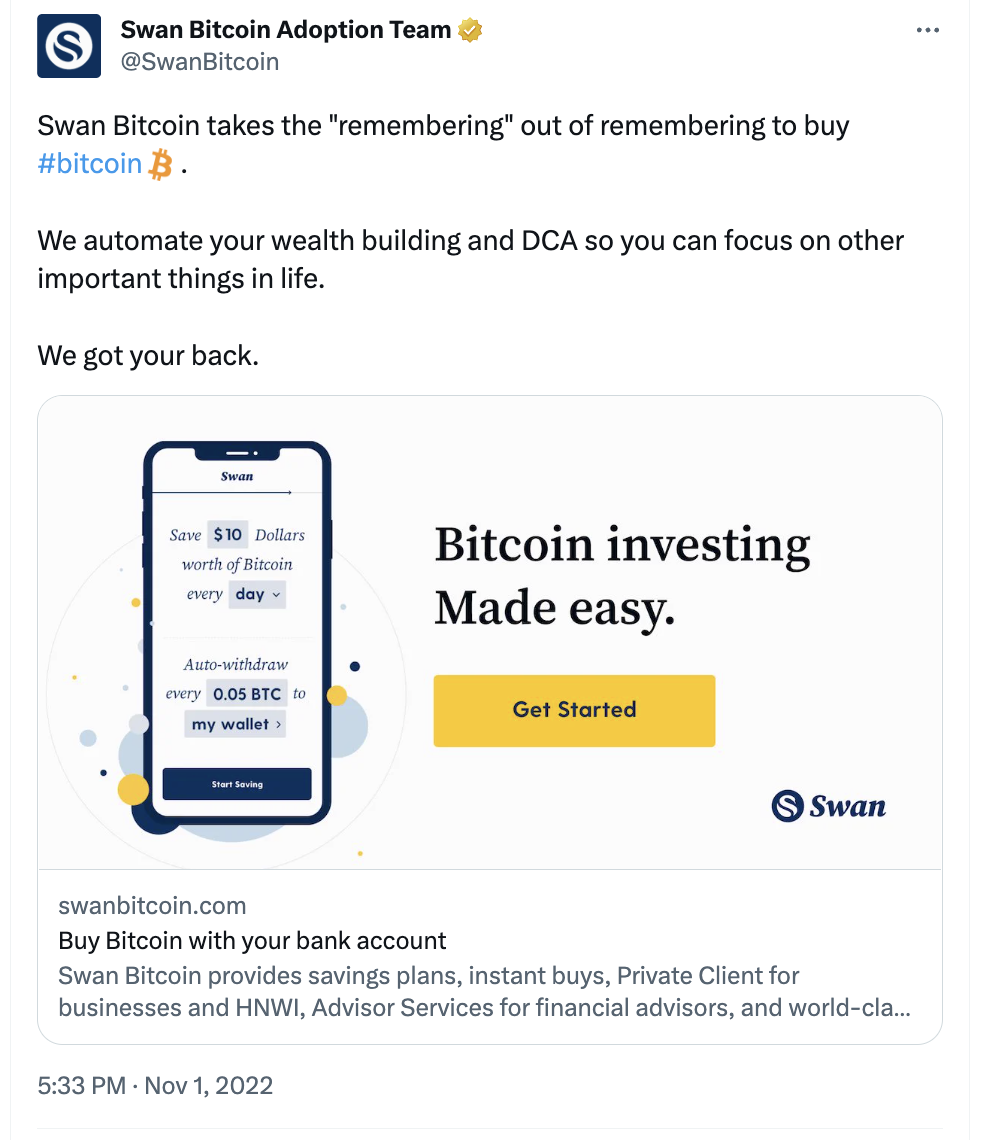
Buy automatically every day, week, or month, starting with as little as $10.
There’s no single answer. Look for regulated, Bitcoin-focused services that let you withdraw to your own wallet, such as Swan, River and Strike, or large brokers like Fidelity.
It’s simpler to hold in a brokerage account, but you own fund shares, not Bitcoin, and pay between 0.25% to 1.5% per year.
Yes. The Swan IRA charges a 1% fee on Bitcoin buys and sells, plus 0.02% of assets on the platform a month with a $20 minimum. Compare options in our Bitcoin IRA guide.
Yes. Cash App lets you withdraw Bitcoin for free at standard speed. However the withdrawal limits are very slow so many users report having funds stuck on Cash app for months before they can take custody of their entire Bitcoin position.
Celsius paused withdrawals in June 2022, FTX filed for bankruptcy in November 2022 after a wave of withdrawals, Robinhood blocked customer withdrawals from 2018 to 2022, and Bitget paused withdrawals after a hack in September 2026.
Brandon is an entrepreneur, writer, speaker, and passionate Bitcoiner. His articles have been read by more than 2 million people online. Most well known for exploring the parallels between bitcoin and mycelium.
Drew, a class of 2013 Bitcoiner, is a Research Analyst for Swan Bitcoin.
He has worked in institutional VC/PE, FinTech, and DLT consulting for over six years. He also brings over twelve years of experience working with national nonprofits and start-ups in education and software development in several leadership roles.
In this article
Thoughts on Bitcoin from the Swan team and friends.
Bitcoin’s reliability is leading the world on a path towards greater economic stability.
Expect the fires from FTX to continue to burn and claim more victims along the way. If anything, this event has provided a tough lesson on why Bitcoin is different and why self-custody is vital.
We believe that a global, Nasdaq-listed, Bitcoin-only financial services company will play a key role in winning the race to avoid the war, so we’re building it.