


Bitcoin Correlation With Stocks: S&P 500 & Nasdaq Data


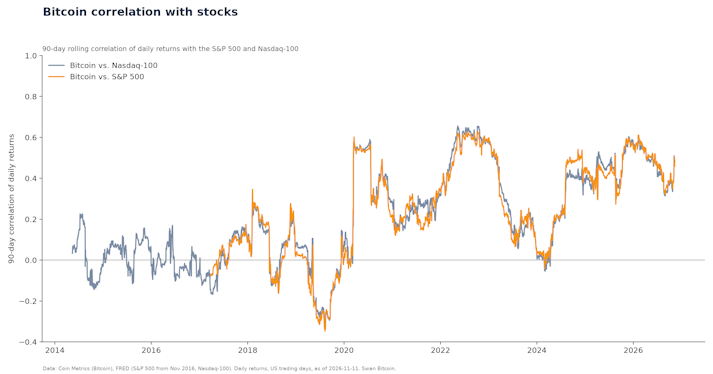
Bitcoin’s correlation with the S&P 500 was 0.42 in 2025 and 0.46 over the last 90 days (Nov 2026). Yearly data since 2017, Nasdaq, dollar and crash days.
In this article
Bitcoin’s hashrate was about 966 exahashes per second (EH/s) on November 16, 2026, with mining difficulty at 134.82 trillion, according to mempool.space. That is 966 quintillion guesses every second, about 26% below the all-time high of roughly 1,306 EH/s set on October 25, 2025. Hashrate is the total computing power miners point at Bitcoin: the higher it is, the more energy and hardware an attacker would have to outspend to rewrite the ledger.
Hashrate: about 966 EH/s (mempool.space estimate)
Difficulty: 134.82 trillion at block 976,146 (down 9.1% on November 14)
Next difficulty adjustment: block 977,760, around November 25, estimated +7%
Hashrate needed to mine 1 BTC a day: about 2.14 EH/s
Hashprice: about $30.20 per PH/s per day (Swan estimate)
As of: November 16, 2026, 16:06 UTC
How today’s figure compares (daily averages from mempool.space):
All-time high: about 1,306 EH/s on October 25, 2025.
One year ago: about 1,100 EH/s on November 15, 2025. The daily average on November 15, 2026 was about 926 EH/s, 16% lower.
Two years ago: about 644 EH/s on November 15, 2024. The November 15, 2026 daily average is about 44% higher.
The network does not report hashrate directly. Trackers estimate it from the current difficulty and how quickly recent blocks were found, so they disagree a little on the same day: on November 16, 2026, CoinWarz showed about 1,140 EH/s at block 976,146, while mempool.space’s estimate was about 966 EH/s.
Hashrate measures how much computing power is working on Bitcoin’s proof-of-work. Every miner repeatedly runs the block header through the SHA-256 hash function, changing a number each time, until one of them finds a hash below the network’s target. Each attempt is one hash. Network hashrate is the sum of all those attempts per second.
Hashrate is not the same as mining difficulty. Difficulty is the target miners have to hit, and the protocol resets it every 2,016 blocks so that blocks keep arriving about every 10 minutes. When hashrate rises, blocks come faster for a while, then difficulty rises to match. A higher hashrate does not make transactions slower.
Hashrate is counted in hashes per second (H/s), with the usual metric prefixes:
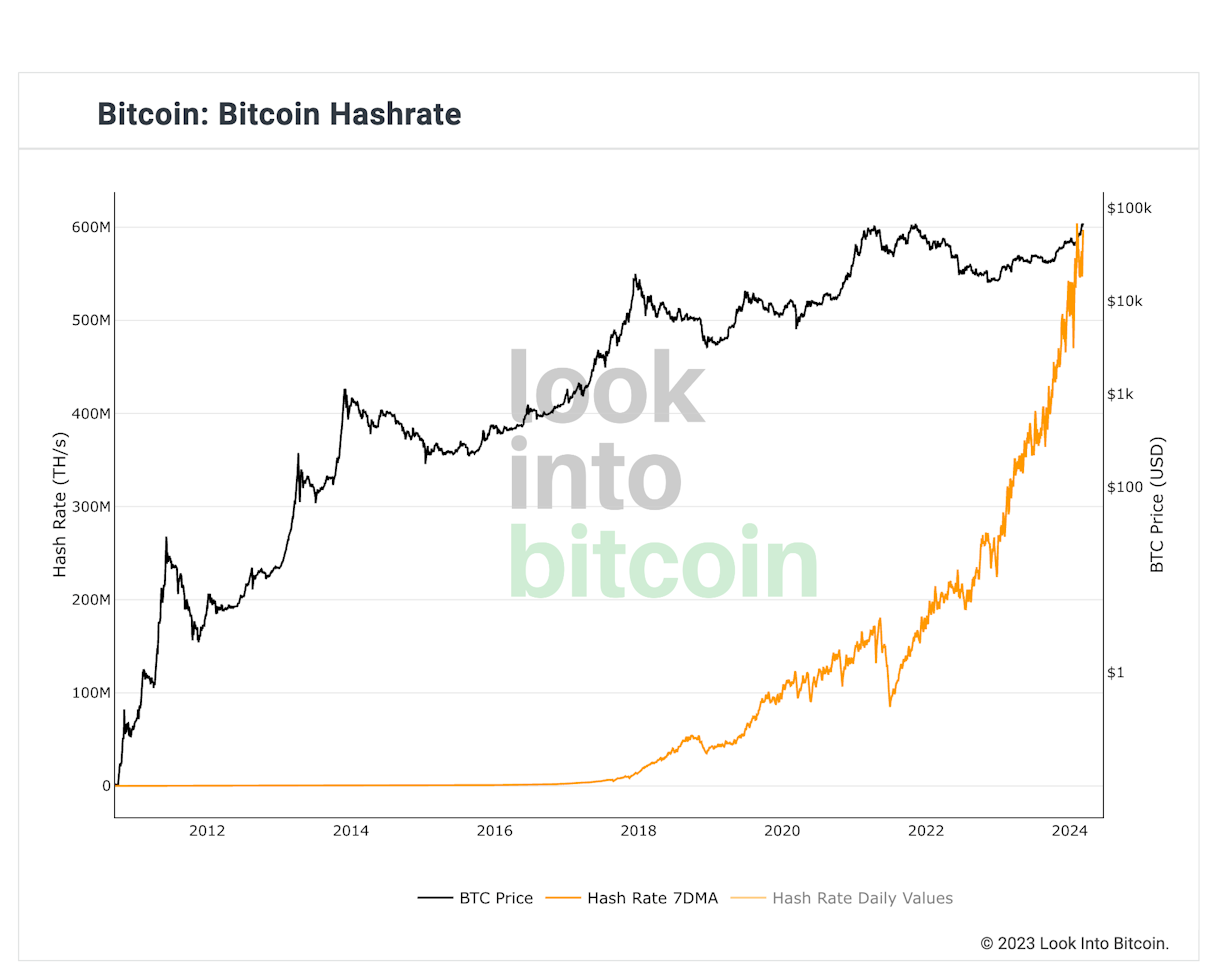
LookintoBitcoin
1 TH/s (terahash) = 1 trillion hashes per second. Individual mining machines are rated in TH/s.
1 PH/s (petahash) = 1,000 TH/s.
1 EH/s (exahash) = 1,000 PH/s, or 1 quintillion (10^18) hashes per second. Network hashrate is quoted in EH/s.
At 966 EH/s, Bitcoin miners make about 966 quintillion guesses every second.
About 2.14 EH/s, running for a full day, to earn 1 BTC on average at November 16, 2026 difficulty. That is about 0.22% of the whole network. The arithmetic uses only the difficulty and the block reward:
A block takes, on average, difficulty × 2^32 hashes to find: 134.82 trillion × 4,294,967,296 ≈ 579 sextillion hashes.
Each block paid about 3.138 BTC over the last 144 blocks (the 3.125 BTC subsidy plus fees), so 1 BTC takes about 185 sextillion hashes.
A day has 86,400 seconds. 185 sextillion ÷ 86,400 ≈ 2.14 quintillion hashes per second, or about 2.14 EH/s.
Before the November 14 difficulty adjustment (−9.1%), the same calculation gave about 2.34 EH/s. If the next adjustment, expected around November 25, raises difficulty by the roughly 7% mempool.space estimated on November 16, it would give about 2.29 EH/s. These are averages: mining is a lottery, so any one day’s result varies.
Not with a home setup. 2.14 EH/s is about 3,700 of Bitmain’s Antminer S23 Hydro, which Hashrate Index lists at 580 TH/s and 5,510 watts each. That fleet would draw about 20 megawatts, the scale of an industrial mining site.
One S23 Hydro on its own would earn about 0.00027 BTC a day (about $17.50 at $64,499 per Bitcoin) while using about 132 kWh of electricity. At that rate, one machine would take about 10 years to earn 1 BTC, and longer if difficulty keeps rising. Whether that is profitable depends on what you pay for power; our guide to the cost of mining 1 Bitcoin works through electricity prices.
Difficulty is set by the protocol; hashrate is set by miners. Every 2,016 blocks, roughly every two weeks, Bitcoin compares how long those blocks took with the 10-minute target and adjusts difficulty up or down to match.
On November 16, 2026, difficulty was 134.82 trillion at block 976,146.
The latest adjustment, at block 975,744 on November 14, lowered it by about 9.1%, after blocks had been arriving about every 11 minutes. The one before, on October 29, raised it by about 5.5%.
The next one is due at block 977,760, around November 25. Blocks have been arriving about every 8.8 minutes since, faster than the target, so mempool.space estimated difficulty would rise by about 7%. That estimate changes until the adjustment happens.
This feedback loop is why Bitcoin keeps a steady issuance schedule no matter how much hardware joins or leaves.
A rising hashrate means more machines and more electricity are competing for the same block reward. Four things follow:
More security. An attacker would need more hardware and power to outpace the honest network.
Higher difficulty. At the next adjustment, difficulty rises so blocks go back to about 10 minutes.
Less revenue per machine. The roughly 450 BTC of daily subsidy is split across more hashrate, so each terahash earns less unless the Bitcoin price or fees rise.
Miners expect to profit. New machines take months to order and install, so hashrate growth reflects miners' past investment decisions. It does not tell you where the price is going.
A falling hashrate means the opposite: machines are switching off, usually because the price dropped, power got more expensive, or a halving cut the reward.
Hashprice is what one unit of hashrate earns per day, usually quoted in dollars per PH/s per day. It ties together hashrate, difficulty, the Bitcoin price and transaction fees.
Our estimate for November 16, 2026, from mempool.space data:
In the last 144 blocks, miners earned 451.94 BTC: the 3.125 BTC subsidy per block plus 1.94 BTC in fees (0.4% of the total). That is about 3.138 BTC per block.
At a difficulty of 134.82 trillion, one PH/s running for a day earns on average about 0.000468 BTC, or roughly 46,800 sats.
At $64,499 per Bitcoin (CoinGecko), hashprice was about $30.20 per PH/s per day.
Hashprice falls when hashrate grows faster than the Bitcoin price, which is what has happened since the last halving (see the table below).
Our calculation from mempool.space’s daily hashrate and historical price data. Prices are approximate for the week of each halving.
2012 halving (November 28, 2012): about 25 TH/s. Bitcoin price about $12.
2016 halving (July 9, 2016): about 1.54 EH/s, roughly 61,000 times the 2012 level. Price about $655, about 52 times higher.
2020 halving (May 11, 2020): about 136 EH/s, about 88 times the 2016 level. Price about $9,300, about 14 times higher.
2024 halving (April 20, 2024): about 642 EH/s, about 4.7 times the 2020 level. Price about $63,800, about 6.9 times higher.
Now (November 15, 2026): about 926 EH/s, about 44% above the 2024 halving. Price $64,499 on November 16, about 1% above the 2024 halving level.
Two patterns stand out. Hashrate growth has slowed every cycle as mining moved from hobbyist hardware to industrial sites, and since 2024 hashrate has grown much faster than price. Each terahash now earns far less than it did at the last halving, which squeezes miners with older machines or expensive power. The next halving, expected in 2028, will cut the subsidy again to 1.5625 BTC.
Blockchain.com
What is Bitcoin mining? Mining adds new blocks of transactions to the blockchain and secures the network. Miners spend electricity to find a valid block and are paid in newly issued Bitcoin plus fees. It is Bitcoin’s answer to the Byzantine Generals Problem: a way for strangers to agree on one history without trusting each other. Mining is profitable only when that reward beats the cost of power and hardware.
What is SHA-256? SHA-256 (Secure Hash Algorithm, 256-bit) is the hash function used in Bitcoin’s proof-of-work. It turns the block header into a fixed-size, unpredictable output. For a deeper explanation, see what Bitcoiners need to know about hashes.
What is a nonce? The nonce is a number in the block header that miners change on each attempt. Changing it produces a completely different hash.
How do miners find a valid block? By trial and error. They change the nonce (and other fields) and hash again, billions of times per second per machine, until the result is below the target.
What is block time? The average time between blocks. Bitcoin targets 10 minutes and uses the difficulty adjustment every 2,016 blocks to stay close to it.
Because each hash is a lottery ticket, a solo miner could wait years to find a block. Most miners join pools, which combine hashrate and pay out smaller, steadier rewards. Swan’s Yan Pritzker explains mining as a lottery in this thread.
Share of blocks found in the 30 days to November 16, 2026, per mempool.space:
Foundry USA: 25.8%
AntPool: 19.7%
F2Pool: 16.8%
ViaBTC: 9.0%
SpiderPool: 6.2%
MARA Pool: 5.2%
Luxor: 4.7%
SECPOOL: 4.1%
The two largest pools together found about 45% of blocks. The chart below shows how the split looked in early 2024.
Hashrate Index
A high hashrate makes Bitcoin expensive to attack. To rewrite recent blocks, an attacker would need more hashrate than the rest of the network combined.
51% attacks. If one person or group controlled more than half of the hashrate, they could reorder their own recent transactions and try to double-spend. They still could not create Bitcoin out of thin air or take coins from other people’s addresses. In practice:
Only a pool operator is likely to get close, and attacking would destroy the value of the Bitcoin they earn.
Miners can switch pools in minutes, so a pool nearing 51% tends to lose hashrate.
Hashrate does not let miners change Bitcoin’s rules. Nodes reject blocks that break them.
Contentious hard forks. A hard fork is a rule change that older software rejects, so the chain splits if part of the network refuses it.

In the blocksize war, large companies, including Coinbase, and a large share of hashrate backed bigger blocks. Users running nodes refused the change, and Bitcoin kept its rules.
Bitcoin Cash split off in 2017 with a larger block size and has lost relevance since. Our history of Bitcoin forks covers every split since.
Not directly: the economic link runs mainly from price to hashrate, with a lag. A higher price makes mining more profitable, so miners order machines and hashrate climbs over the following months. When price falls or a halving cuts the reward, the least efficient machines switch off.
The halving data above shows how loose the link is over shorter periods. Between the 2020 and 2024 halvings, hashrate grew about 4.7 times and price about 6.9 times. Since the 2024 halving, hashrate has grown about 44% while price is up about 1%. In 2021, hashrate fell by about two-thirds in about ten weeks when China moved against mining, and the network kept producing blocks. Some argue that rising hashrate signals miners' confidence, but hashrate has never been a reliable price signal. Swan does not make price predictions; for what analysts forecast, see our Bitcoin price prediction roundup.
LookintoBitcoin
2021 China ban: after China moved against mining, network hashrate fell from about 198 EH/s (April 16, 2021) to about 61 EH/s (June 28, 2021), as miners relocated, many to the U.S. (our review of the 2021 hash rate migration).
April 2024 halving: the subsidy fell from 6.25 to 3.125 BTC per block.
All-time high: about 1,306 EH/s on October 25, 2025.
November 2026: about 966 EH/s, with difficulty at 134.82 trillion after a 9.1% drop on November 14, and hashprice near $30.20 per PH/s per day.
Today’s hashrate is about 16 times the 2021 low.
mempool.space: free hashrate and difficulty charts, the next difficulty adjustment estimate and pool shares.
Hashrate Index by Luxor: hashprice and in-depth mining data.
TimechainStats: network statistics at a glance.
Timechain Calendar: visual summaries of hashrate and difficulty.
Blockchain.com and CoinWarz: long-term hashrate charts.
In this 2024 episode of HashrateUp, Swan’s podcast about Bitcoin mining and energy, Haris Basit, Chief Strategy Officer of Bitdeer, discusses vertical integration and ASIC development.
Hashrate: mempool.space’s current network estimate, read on November 16, 2026 at 16:06 UTC (block 976,146). Daily comparisons use mempool.space’s daily averages.
Hashrate needed for 1 BTC per day: difficulty × 2^32 ÷ (average reward per block × 86,400 seconds). This uses only difficulty and the block reward, so it does not depend on which hashrate estimate you use.
Hashprice: the same formula scaled to 1 PH/s, multiplied by the Bitcoin price from CoinGecko ($64,499 on November 16, 2026, 16:04 UTC). This is Swan’s estimate; Hashrate Index publishes its own figure, which may differ slightly.
Halving table: mempool.space daily hashrate on each halving date and its historical price data for that week.
Hold your IRA with the most trusted name in Bitcoin.
About 966 EH/s on November 16, 2026 (mempool.space estimate). The daily average on November 15 was about 926 EH/s.
About 1,306 EH/s, the daily average on October 25, 2025, per mempool.space.
About 71 PH/s running for the whole month, at November 16, 2026 difficulty: the 2.14 EH/s needed for 1 BTC a day, divided by 30. That is about 123 Antminer S23 Hydro machines at 580 TH/s each.
For Bitcoin, efficiency matters more than raw hashrate. What decides profit is how many joules a machine uses per terahash and what you pay for power. Hashrate Index lists Bitmain’s Antminer S23 Hydro at 580 TH/s and 9.5 joules per terahash. Older or less efficient machines earn the same per terahash but pay more for the electricity behind it.
For one miner, more hashrate means a bigger share of the rewards. For the network as a whole, higher hashrate means the same daily reward is split across more machines, so hashprice falls unless the Bitcoin price or fees rise.
The Bitcoin price, the block reward, transaction fees, difficulty, the cost of power and the efficiency of mining machines. After a halving cuts the reward, older machines may become unprofitable and shut off; if the price rises enough, they can come back.
Blocks arrive more slowly than every 10 minutes until the next difficulty adjustment lowers the target. A very large drop could take several adjustments to work through, while slower blocks push fees up and draw miners back. The network keeps running throughout.
Not realistically. Anyone with a mining machine and power can add hashrate, and difficulty falls to make mining profitable again if many miners leave.
Miners move. When China cracked down in 2021, hashrate fell by about two-thirds in a few months, then recovered and kept growing elsewhere. A ban mostly moves mining revenue to other countries.
It is debated. Mining uses a lot of electricity, but miners seek the cheapest power, which is often surplus or stranded energy, and they can switch off quickly when the grid needs the power.
mempool.space, hashrate and difficulty, mining pools and API data (current hashrate, difficulty adjustment, last-144-block rewards, daily hashrate history and historical prices; block 976,146, November 16, 2026, 16:06 UTC; pool shares November 16, 2026)
Hashrate Index, Antminer S23 Hydro specifications (580 TH/s, 5,510 W, 9.5 J/TH; read November 16, 2026)
CoinWarz, Bitcoin hashrate (about 1,140 EH/s at block 976,146, November 16, 2026)
CoinGecko, Bitcoin price ($64,499, November 16, 2026, 16:04 UTC)
Yan Pritzker, mining as a lottery thread (March 14, 2019)
Mickey Koss became a freelance writer in the Bitcoin space in an attempt to build a proof of work portfolio for when he left the Army. He graduated from West Point with a degree in Economics before serving in the Army for nearly a decade. He became orange pilled in graduate school and is now a regular contributor to Forbes, Bitcoin Magazine, and Bitcoin News. He’s been on popular podcasts such as BTC Sessions’ Why Are We Bullish, and is a regular on Café Bitcoin.
Drew, a class of 2013 Bitcoiner, is a Research Analyst for Swan Bitcoin.
He has worked in institutional VC/PE, FinTech, and DLT consulting for over six years. He also brings over twelve years of experience working with national nonprofits and start-ups in education and software development in several leadership roles.
In this article
Thoughts on Bitcoin from the Swan team and friends.
Bitcoin’s correlation with the S&P 500 was 0.42 in 2025 and 0.46 over the last 90 days (Nov 2026). Yearly data since 2017, Nasdaq, dollar and crash days.
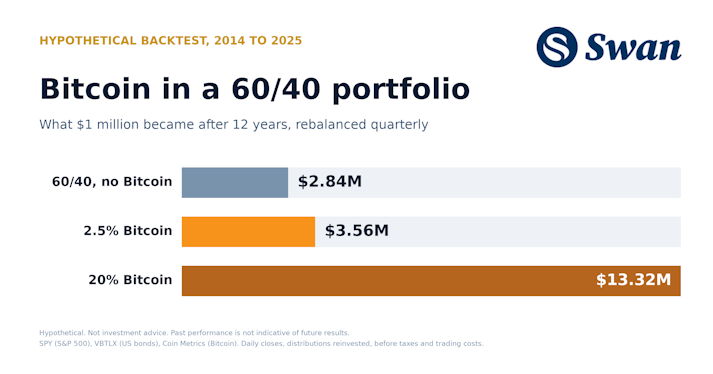
How much Bitcoin to hold in a 60/40 portfolio: 2.5% lifted annual returns from 9.1% to 11.2% (2014–2025). Results from 1% to 20%, drawdowns and method.
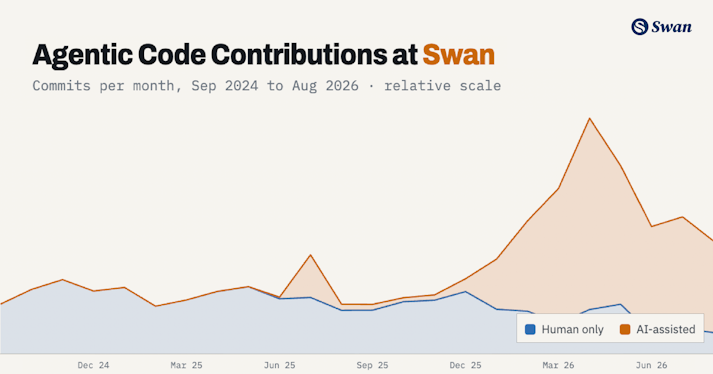
How Swan built an agentic software factory that finds production bugs, reaches consensus on the fix, opens the PR, and proves it works before a human merges.