




Bitcoin Correlation With Stocks: S&P 500 & Nasdaq Data


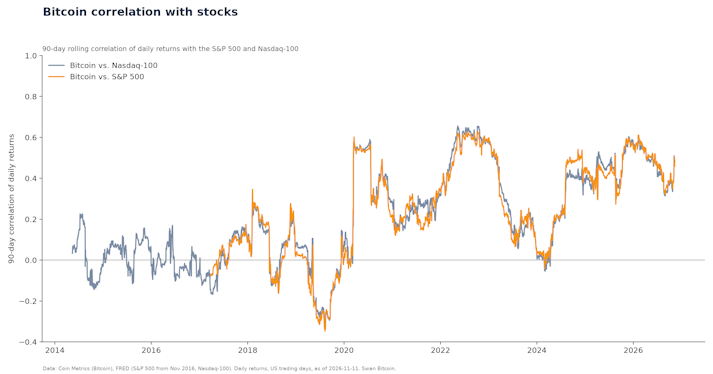
Bitcoin’s correlation with the S&P 500 was 0.42 in 2025 and 0.46 over the last 90 days (Nov 2026). Yearly data since 2017, Nasdaq, dollar and crash days.
In this article
Yes, Binance is in trouble again as of November 2026. On October 29, 2026, hackers stole about $6.3 billion from Binance’s hot wallets, the largest exchange hack on record, and the FBI has blamed North Korea. Separately, the U.S. Justice Department is reviewing whether Binance has complied with its 2023 guilty plea, and federal prosecutors in Manhattan are reportedly investigating possible Iran sanctions violations. Binance says it will cover customer losses from the hack and that it has a zero-tolerance policy for sanctions violations. This page explains what happened, what is still open, and what it means if you keep Bitcoin on an exchange.
Hack (October 29, 2026): about $6.3 billion taken from hot wallets. Binance says it will absorb the losses, not its users, and that it had restored 98% of the $6.34 billion in affected assets by November 3 (CNBC).
DOJ review (October 2026): the head of the Justice Department’s criminal division said officials are “reviewing Binance’s compliance with its 2023 agreement,” without saying Binance broke it (Bloomberg Law).
Sanctions probe (reported September 2026): the U.S. attorney’s office in Manhattan is reportedly examining whether Binance let Iran-linked trades continue. No charges have been filed (CoinDesk).
CZ: Binance’s founder pleaded guilty in 2023, served four months in prison in 2024, and received a presidential pardon on October 23, 2025.
SEC case: dismissed with prejudice in May 2025.
On October 29, 2026, Binance announced that about $6.3 billion in tokens had been stolen from its hot wallets, the online wallets an exchange uses to process withdrawals (CNBC). It is the largest exchange hack on record, about four times the $1.5 billion taken from Bybit in 2025.
Who did it: the FBI said North Korea was responsible. Blockchain analytics firms tied the attack to the North Korean group known as TraderTraitor.
How it happened: Binance first blamed “a compromised DevOps engineer’s laptop.” Co-CEO Richard Teng later said the attackers “spent months building their way in”: in June they lured an engineer into installing a fake developer tool, and in September they posed as recruiters and interviewed another engineer (CNBC).
What happened to customers: Binance halted withdrawals, then resumed them on November 1, starting with the Bitcoin network. It said “Binance will absorb the financial impact of these stolen funds, not our users,” drawing on its Secure Asset Fund for Users (SAFU), its futures insurance fund and its corporate treasury. About $3 billion of the stolen funds was frozen with help from stablecoin issuers including Tether and Circle.
In 2023, Binance pleaded guilty and agreed to strict compliance terms. In 2026, U.S. authorities began checking whether it kept them:
February 23, 2026: The Wall Street Journal reported on Binance’s compliance staff and Iran-linked transactions. On March 11, 2026, Binance sued Dow Jones, the Journal’s publisher, for defamation in federal court in New York, and the Journal reported the same day that the DOJ was investigating whether Iran used Binance to move funds in violation of U.S. sanctions (CoinDesk).
September 22, 2026: Bloomberg reported, citing unnamed people, that the U.S. attorney’s office in Manhattan is examining whether Binance failed to halt trading that violated Iran sanctions. Binance said: “We maintain a zero-tolerance policy for sanctions violations.”
October 9, 2026: DOJ criminal division head Tysen Duva said officials were reviewing Binance’s compliance with its 2023 agreement. He did not say Binance was in violation.
None of these has led to new charges as of November 11, 2026. If the DOJ concluded Binance breached its plea agreement, it could seek further penalties, so this is the open question to watch.
On November 21, 2023, Binance pleaded guilty to criminal violations concerning unlicensed money transmitting, the Bank Secrecy Act and U.S. sanctions laws. Changpeng Zhao (CZ) pleaded guilty to causing Binance to violate the Bank Secrecy Act by failing to implement an effective anti-money laundering program. Together with the CFTC, FinCEN and OFAC settlements, Binance agreed to pay more than $4.3 billion (CFTC). The CFTC portion alone was $1.35 billion in disgorgement and a $1.35 billion penalty for Binance, plus $150 million from Zhao.
Zhao stepped down as CEO the same day and was replaced by Richard Teng.
On April 30, 2024, a federal judge in Seattle sentenced Zhao to four months in prison (Engadget). He was released on September 27, 2024 (TechCrunch).
On October 23, 2025, the White House confirmed that President Trump had pardoned Zhao. Press secretary Karoline Leavitt said there were “no allegations of fraud or identifiable victims” (PBS).
On December 3, 2025, Binance named co-founder Yi He co-CEO alongside Richard Teng (The Block).
On June 5, 2023, the SEC sued Binance, its U.S. affiliate BAM Trading and Zhao, alleging among other things that Binance let high-value U.S. customers keep trading on Binance.com while claiming to block them.
The complaint quoted Binance’s chief compliance officer writing in December 2018: “we are operating as a fking unlicensed securities exchange in the USA bro.”
On May 29, 2025, the SEC and Binance jointly asked the court to dismiss the case with prejudice, so the SEC cannot refile the same claims. The case had been on hold since February 2025 while the SEC’s new Crypto Task Force reviewed its approach.
Before and after the 2023 plea, regulators in several countries pushed Binance out or restricted it:
Netherlands, June 2023: Binance left the Dutch market after failing to register with the Dutch regulator.
Russia, September 2023: Binance sold its Russian business to CommEX and exited the country.
India, December 2023 to January 2024: India blocked access to offshore exchanges including Binance, and Apple and Google removed the app from their Indian stores.
Binance has said it will cover customer losses from the October 2026 hack, and it resumed withdrawals within days. But the hack shows the core risk of any exchange: while your Bitcoin sits there, you are trusting the exchange’s security, solvency and legal standing. Withdrawals can be paused at any time, as they were after this hack.
CZ’s “funds are SAFU” became a slogan in 2018. In 2026, SAFU and Binance’s treasury did cover the hack. The safer approach is not to need them: keep long-term savings in a wallet only you control. See our guide to Bitcoin cold storage and our ranking of the best Bitcoin wallets.
Binance grew by listing a long tail of tokens, running token launches and issuing its own token, BNB, which the SEC’s 2023 complaint (since dismissed) called an unregistered security. Early buyers of new tokens tend to gain at later buyers' expense, a version of the Cantillon effect. Bitcoin has no such insiders: it had no pre-sale and no company issuing it.
If you buy Bitcoin on any platform, the same rule applies: move it to your own wallet. To compare where to buy, see our guides to the best Bitcoin exchanges, Kraken and whether Coinbase is safe. Swan charges $0 for withdrawals to your own wallet. For retirement savings, see the Swan Bitcoin IRA and our comparison of IRA providers that offer Bitcoin.
Hold your IRA with the most trusted name in Bitcoin.
Yes. It lost about $6.3 billion in a hack on October 29, 2026, and the DOJ is reviewing whether it complied with its 2023 plea deal, with a reported Manhattan investigation into Iran sanctions. No new charges had been filed as of November 11, 2026.
Binance says no. It said it would absorb the losses using its SAFU fund, insurance fund and treasury, and that it had restored 98% of the affected assets by November 3, 2026.
The FBI said North Korea was responsible. Blockchain analysts linked the attack to the TraderTraitor group.
Yes. President Trump pardoned Changpeng Zhao on October 23, 2025. Zhao had pleaded guilty in 2023 and served four months in prison in 2024.
No. The SEC’s 2023 lawsuit was dismissed with prejudice on May 29, 2025.
Richard Teng and co-founder Yi He are co-CEOs. Teng replaced Zhao in November 2023, and Yi He was named co-CEO on December 3, 2025.
For long-term savings, keep Bitcoin in a wallet you control rather than on any exchange. Exchanges can pause withdrawals, as Binance did after the 2026 hack.
CNBC, Binance resumes withdrawals following $6.3 billion hack (October 31, 2026)
CNBC, Binance co-CEO Richard Teng says hackers used fake job interviews (November 3, 2026)
Bloomberg Law, DOJ scrutinizes Binance compliance with 2023 settlement deal (October 9, 2026)
CoinDesk, Binance probed by U.S. federal prosecutors for sanctions violations (September 22, 2026)
CoinDesk, Binance sues Wall Street Journal (March 11, 2026)
CFTC, press release 8825-23 on Binance and Changpeng Zhao (November 21, 2023)
Engadget, Binance founder Changpeng Zhao sentenced to four months in prison (April 30, 2024)
TechCrunch, Binance founder CZ released from custody (September 27, 2024)
PBS NewsHour, Trump pardons Binance founder Changpeng Zhao (October 23, 2025)
The Block, Binance appoints co-founder Yi He as co-CEO (December 3, 2025)
SEC, Litigation Release No. 26316: SEC v. Binance dismissed (May 29, 2025)
TechCrunch, Google pulls Binance and other crypto apps from India’s Play Store (January 13, 2024)
Drew, a class of 2013 Bitcoiner, is a Research Analyst for Swan Bitcoin.
He has worked in institutional VC/PE, FinTech, and DLT consulting for over six years. He also brings over twelve years of experience working with national nonprofits and start-ups in education and software development in several leadership roles.
In this article
Thoughts on Bitcoin from the Swan team and friends.
Bitcoin’s correlation with the S&P 500 was 0.42 in 2025 and 0.46 over the last 90 days (Nov 2026). Yearly data since 2017, Nasdaq, dollar and crash days.
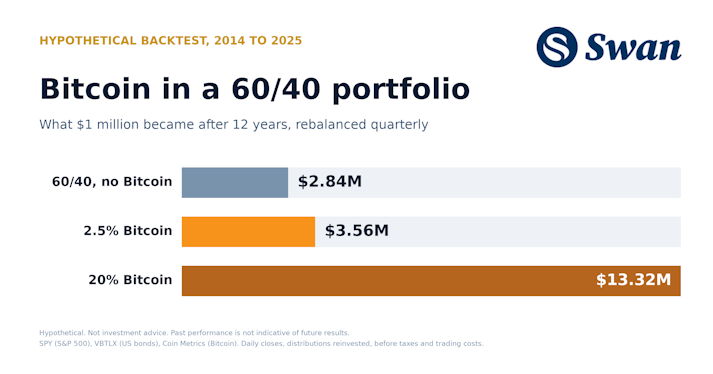
How much Bitcoin to hold in a 60/40 portfolio: 2.5% lifted annual returns from 9.1% to 11.2% (2014–2025). Results from 1% to 20%, drawdowns and method.
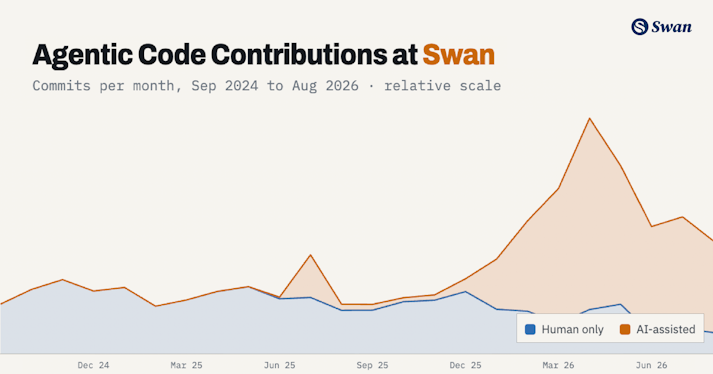
How Swan built an agentic software factory that finds production bugs, reaches consensus on the fix, opens the PR, and proves it works before a human merges.