


Bitcoin Correlation With Stocks: S&P 500 & Nasdaq Data


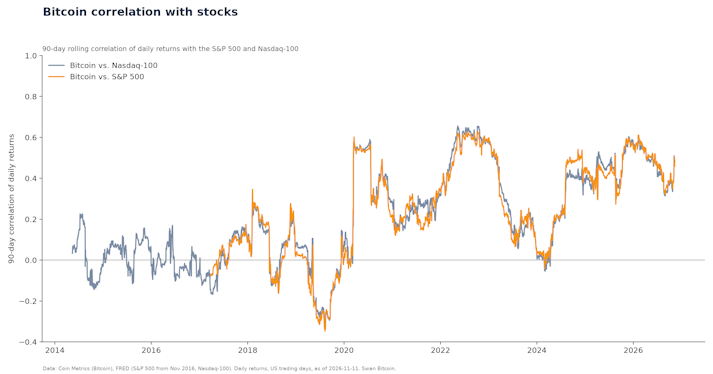
Bitcoin’s correlation with the S&P 500 was 0.42 in 2025 and 0.46 over the last 90 days (Nov 2026). Yearly data since 2017, Nasdaq, dollar and crash days.
In this article
It costs about $75,500 on average to mine one Bitcoin in 2026. That is the weighted average cash cost public mining companies reported for the second quarter of 2026, according to CoinShares (report published September 15, 2026). At those cost levels and a Bitcoin price of about $64,500 on November 16, 2026, the average listed miner spends more cash to produce a coin than the coin sells for.
Electricity alone costs about $24,000 to $45,000 per Bitcoin with a current machine on cheap industrial power ($0.05 per kWh), at November 2026 difficulty. At the average US home electricity price (18.2¢ per kWh in August 2026), the power bill alone is more than a Bitcoin is worth on every machine in this guide. Your own cost depends on two numbers: what you pay for electricity and how efficient your machine is.
Bitcoin price: $64,499 (CoinGecko, Nov 16, 2026)
Difficulty: 134.82 trillion, set on November 14, 2026 (−9.1%, down from 148.36 trillion). The next adjustment, expected around November 25, was estimated at about +7%, an estimate that changes until then (mempool.space, Nov 16, 2026).
Network hashrate: about 966 EH/s, mempool.space estimate (mempool.space, Nov 16, 2026). New to the term? See what Bitcoin hashrate is.
Hashprice (miner revenue per PH/s per day): $30.06 (Hashrate Index, Nov 16, 2026), up from $29.48 on November 13 after the difficulty drop and still close to the record low of $27.74 set on June 6, 2026
Transaction fees: 0.4% of miner revenue over the last 144 blocks, to block 976,146 (mempool.space, Nov 16, 2026)
Average cash cost, public miners (Q2 2026): about $75,500 per BTC (CoinShares)
Average production cost, whole network (Aug 2026): $78,254 per BTC (Checkonchain via Cointelegraph, Aug 12, 2026)
US average electricity price (Aug 2026): 18.16¢ per kWh for homes, 9.64¢ for industry (EIA)
At November 16, 2026 difficulty, mining 1 BTC takes about 487,000 kWh on the most efficient machine and about 897,000 kWh on an older one. Here is what that costs at different power prices. These are electricity only, leaving out the machine, hosting, cooling and staff.
Antminer S23 Hydro (9.5 J/TH, 580 TH/s, 5,510 W, water-cooled): $14,600 at $0.03/kWh · $24,300 at $0.05 · $34,100 at $0.07 · $48,700 at $0.10 · $88,400 at the 18.2¢ US home average
Antminer S21 XP (13.5 J/TH, 270 TH/s, 3,645 W, air-cooled): $20,800 at $0.03/kWh · $34,600 at $0.05 · $48,400 at $0.07 · $69,200 at $0.10 · $125,600 at 18.2¢
Antminer S21 (17.5 J/TH, 200 TH/s, 3,500 W, air-cooled): $26,900 at $0.03/kWh · $44,800 at $0.05 · $62,800 at $0.07 · $89,700 at $0.10 · $162,900 at 18.2¢
How we got there, step by step:
Hashes per block. Difficulty × 2^32 ÷ 10^12 = 134.82 trillion × 4.295 billion ÷ 1 trillion = about 579 billion terahashes of work per block, on average.
Bitcoin per block. The 3.125 BTC block subsidy plus about 0.013 BTC in fees (the average over the last 144 blocks) = about 3.138 BTC.
Hashes per Bitcoin. 579 billion ÷ 3.138 = about 185 billion terahashes per BTC.
Energy per Bitcoin. A machine rated at X joules per terahash uses 185 billion × X joules per BTC. Divide by 3.6 million to get kWh. For the 13.5 J/TH S21 XP: 185 billion × 13.5 ÷ 3.6 million = about 691,900 kWh.
Cost. Multiply by your price per kWh: 691,900 × $0.05 = about $34,600.
Difficulty changes every 2,016 blocks, about every two weeks, and every figure above moves with it. The November 14 adjustment cut each one by about 9.1%. If the next adjustment, expected around November 25, raises difficulty by the roughly 7% mempool.space estimated on November 16, each figure would rise by about 7% (the S21 XP at $0.05 would rise to about $37,000).
These estimates line up with what public miners actually pay. In Q2 2026, CleanSpark’s electricity came to $44,405 per BTC mined and Riot’s to $39,978 per BTC, net of demand-response credits (CoinShares).
The breakeven power price is the most you can pay for electricity before the power bill alone uses up everything a machine earns. At November 16, 2026 difficulty and a Bitcoin price of $64,499, it is:
Antminer S23 Hydro (9.5 J/TH): about 13.2¢ per kWh
Antminer S21 XP (13.5 J/TH): about 9.3¢ per kWh
Antminer S21 (17.5 J/TH): about 7.2¢ per kWh
That is the Bitcoin price divided by each machine’s energy use per coin (486,900, 691,900 and 896,900 kWh). The same answer comes from the Hashrate Index hashprice of $30.06 per PH/s per day divided by each machine’s daily use per PH/s (228, 324 and 420 kWh).
Compare those with US prices. The average industrial rate was 9.64¢ per kWh in August 2026 (EIA), so at today’s numbers only the newest water-cooled machines cover their power bill at an average industrial rate, and no machine covers it at the 18.16¢ home average. At $0.05 per kWh, electricity takes about 38% of an S23 Hydro’s revenue, 54% of an S21 XP’s and 70% of an S21's, before paying for the machine. The breakeven rises if the Bitcoin price does (see what analysts forecast for 2026 to 2040) and falls each time difficulty climbs.
The all-in cost includes machines (which lose value fast), buildings, staff, financing and hosting fees. CoinShares' Q2 2026 data shows a wide spread between companies, in all-in cost per BTC:
American Bitcoin (ABTC): $76,529
Bitdeer: $89,737
Riot Platforms: $113,499
HIVE: $116,739
CleanSpark: $135,691
IREN: $141,593
MARA: $163,866
Cash costs, which leave out depreciation and stock pay, are lower but still close to the price: $71,995 per BTC at CleanSpark, $74,955 at Riot and $86,126 at MARA, against $43,851 at American Bitcoin, the cheapest producer in the table. At $64,499, Bitcoin is below every company’s Q2 all-in cost and below the $75,500 average cash cost. Miners have been squeezed like this before: see the great miner squeeze of 2022.
For most miners, not at November 2026 prices. Bitcoin ended June 2026 at $58,400, below the $75,500 average cash cost, and hashprice hit a record daily low of $27.74 per PH/s per day on June 6, 2026. CoinShares reported that a rebound to about $77,000 had lifted most operators back above cash breakeven by mid-September. By November 16, Bitcoin had fallen to about $64,500, while hashprice edged up to $30.06 after the 9.1% difficulty drop on November 14. Hashrate Index wrote on November 9 that at $32 per PH/s per day, hashprice was “at or below breakeven for many miners depending on operating cost and machine model type” (Hashrate Index).
Mining still pays for operators with power well under 5¢ per kWh and the newest machines. For a home miner on average US electricity, it does not: an S21 XP running at home loses about $7.70 a day (see the next section).
On your own, about 22 years. One Antminer S21 XP (270 TH/s, 3,645 W) earns about 0.000126 BTC, or about 12,600 sats, a day in a mining pool at November 16, 2026 difficulty, before pool fees. That is about $8.15 of Bitcoin a day at $64,499.
The machine uses about 87.5 kWh a day. That costs about $4.37 at $0.05 per kWh, which leaves a small margin before paying for the machine. At the 18.16¢ US home average it costs about $15.89 a day, so the miner loses about $7.70 a day.
How long does it take to mine $1 of Bitcoin? With one S21 XP, about 3 hours ($8.15 a day ÷ 24 hours). At the US home electricity average, each $1 of Bitcoin mined costs about $2 in electricity.
That’s why almost all mining happens in pools. You earn a small, steady share of the rewards instead of waiting years to win a whole block.
Only at industrial scale. Mining 1 BTC a day takes about 2.14 EH/s of hashrate at November 16, 2026 difficulty, about 0.22% of the whole network. That is about 7,900 Antminer S21 XP machines drawing about 28.8 megawatts, with an electricity bill of about $34,600 a day at $0.05 per kWh, more than half the value of the coin they mine. The math: 185 billion terahashes per BTC ÷ 86,400 seconds in a day = 2.14 million TH/s.
For scale, the whole network creates about 450 new Bitcoin a day: 144 blocks at 3.125 BTC each, plus fees.
Bitcoin has no central bank or company that issues coins. Instead, miners add a new block of transactions to the blockchain about every 10 minutes, and the network pays the winner in newly created Bitcoin (3.125 BTC per block since the 2024 halving) plus transaction fees.
Winning takes real work: machines run trillions of hashes, and that costs electricity. The cost is what makes the ledger so expensive to attack, the idea at the heart of Satoshi’s white paper. This system is called proof of work, and it solves the Byzantine Generals Problem: how strangers can agree on one history without trusting each other.
The 2024 halving cut the block reward from 6.25 to 3.125 BTC, doubling the cost per coin overnight. The next halving, expected around April 2028, cuts it to 1.5625 BTC. Whether halvings still move the price is debated; see also three myths about the halving.
Fees stayed tiny. Transaction fees were 0.69% of miner revenue in August 2026, near a 10-year low, and 0.4% over the day to November 16. As the subsidy keeps halving, miners will depend more on fees (Lyn Alden on fee-based security).
The move to AI. Listed miners had announced more than $70 billion in AI and high-performance computing contracts by March 2026. By September, CoinShares counted more than $100 billion of disclosed AI backlog, but it supported only about $1.1 billion of annual AI revenue so far. TeraWulf already gets 71% of its revenue from AI leases (CoinShares). Core Scientific paid about $41.9 million to cancel a mining-chip contract with Block (July 2026) as it moves into AI.
More efficient machines. The newest water-cooled machines use about 9.5 J/TH, against 13.5 J/TH for the best air-cooled S21 XP and 17.5 J/TH for the base S21 (Hashrate Index).
For most people, buying is cheaper and simpler.
Mining can make sense if you have power under about $0.05 per kWh, a place to handle the noise and heat, or a way to use the waste heat (for example, heating a building). Lyn Alden explains why Bitcoin’s energy use is not a problem.
Buying makes sense for almost everyone else. At the US home electricity average, electricity alone runs about $88,000 to $163,000 per Bitcoin at November 2026 difficulty, against a price of about $64,500. Add the cost of the machine, which loses value fast and has to make back its price within a few years, and buying is cheaper.
If you want to own Bitcoin, the simplest route is to buy a little at a time (here’s how that compares with investing a lump sum) and move it into a wallet you control.
Network data (difficulty, hashrate, fees) comes from mempool.space on November 16, 2026, at about 16:06 UTC, and the Bitcoin price from CoinGecko at 16:04 UTC the same day. Hashprice comes from Hashrate Index on the same day ($30.06); our own calculation from the same inputs gives about $30.20.
Machine specs are Bitmain’s nameplate ratings as listed by Hashrate Index. Real machines vary by a few percent, and cooling adds to the power bill.
Revenue uses the 3.125 BTC block subsidy plus the average fee per block over the last 144 blocks. Pool fees are left out.
Company costs are CoinShares' Q2 2026 figures, the latest quarter it has published.
The arithmetic is shown in each section, so you can redo it with your own power price and the current difficulty.
Hold your IRA with the most trusted name in Bitcoin.
About $75,500 on average for public miners in Q2 2026 (cash cost, CoinShares). Electricity alone for a current machine on $0.05 power is about $24,000 to $45,000 per Bitcoin at November 16, 2026 difficulty.
About 487,000 to 897,000 kWh of electricity at November 2026 difficulty, depending on the machine (9.5 to 17.5 J/TH). That is about 185 billion terahashes of work per Bitcoin.
Not at home. It takes about 2.14 EH/s, roughly 7,900 Antminer S21 XP machines using about 28.8 megawatts, at November 16, 2026 difficulty.
About 22 years with one Antminer S21 XP in a mining pool, at November 16, 2026 difficulty.
About 3 hours with one Antminer S21 XP, which earns about $8.15 of Bitcoin a day at a $64,499 price.
Only with power well under 5¢ per kWh and the newest machines. The breakeven electricity price is about 7.2¢ to 13.2¢ per kWh at November 16, 2026 numbers, and the US home average is 18.16¢.
Some do. In Q2 2026, cash costs were $43,851 per BTC at American Bitcoin, the cheapest producer CoinShares tracked, and $86,126 at MARA. With Bitcoin near $64,500 in November 2026, many miners are at or below breakeven. Several are turning to AI hosting for steadier income.
About 450 new Bitcoin a day: 144 blocks at 3.125 BTC each. That drops to about 225 a day after the next halving, expected around April 2028.
About 7.2¢ to 13.2¢ per kWh for electricity alone, depending on the machine (17.5 to 9.5 J/TH), at November 16, 2026 difficulty and a Bitcoin price of $64,499.
The 2024 halving cut the reward to 3.125 BTC per block, and difficulty has climbed with hashrate (to 148.36 trillion on October 29, 2026, before a 9.1% drop to 134.82 trillion on November 14). Fees, which could make up the difference, are still under 1% of miner revenue.
CoinShares Bitcoin Mining Report Q2 2026 (published Sep 15, 2026; accessed Nov 16, 2026)
CoinShares Q2 report coverage and June-end price, Let’s Data Science (Sep 16, 2026)
Checkonchain production cost and fee share, Cointelegraph (Aug 12, 2026)
mempool.space: difficulty and next adjustment (Nov 16, 2026)
mempool.space: block rewards and fees, last 144 blocks (Nov 16, 2026)
Hashrate Index: Antminer S23 Hydro specs and hashprice (accessed Nov 16, 2026)
Luxor June 2026 lookback: record-low hashprice (Jul 10, 2026)
Core Scientific exits Block mining deal, Bitcoin.com News (Jul 30, 2026)
Mickey Koss became a freelance writer in the Bitcoin space in an attempt to build a proof of work portfolio for when he left the Army. He graduated from West Point with a degree in Economics before serving in the Army for nearly a decade. He became orange pilled in graduate school and is now a regular contributor to Forbes, Bitcoin Magazine, and Bitcoin News. He’s been on popular podcasts such as BTC Sessions’ Why Are We Bullish, and is a regular on Café Bitcoin.
In this article
Thoughts on Bitcoin from the Swan team and friends.
Bitcoin’s correlation with the S&P 500 was 0.42 in 2025 and 0.46 over the last 90 days (Nov 2026). Yearly data since 2017, Nasdaq, dollar and crash days.
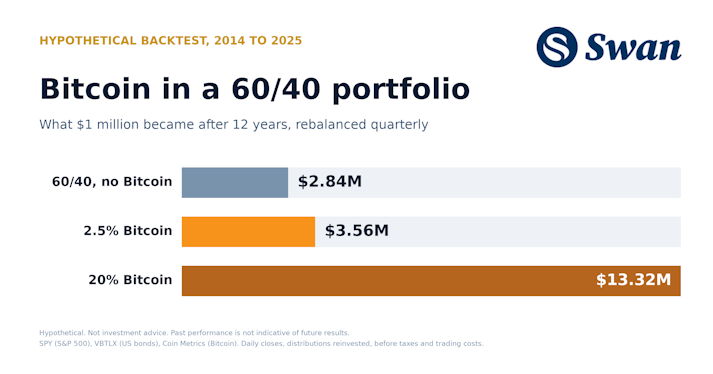
How much Bitcoin to hold in a 60/40 portfolio: 2.5% lifted annual returns from 9.1% to 11.2% (2014–2025). Results from 1% to 20%, drawdowns and method.
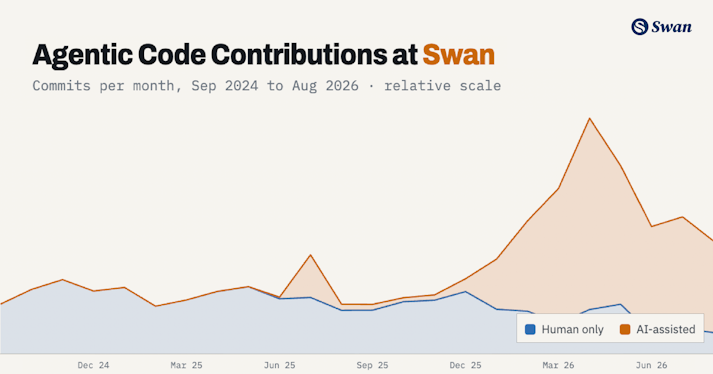
How Swan built an agentic software factory that finds production bugs, reaches consensus on the fix, opens the PR, and proves it works before a human merges.