
Swan’s Agentic Software Factory: Cygnet Evolved


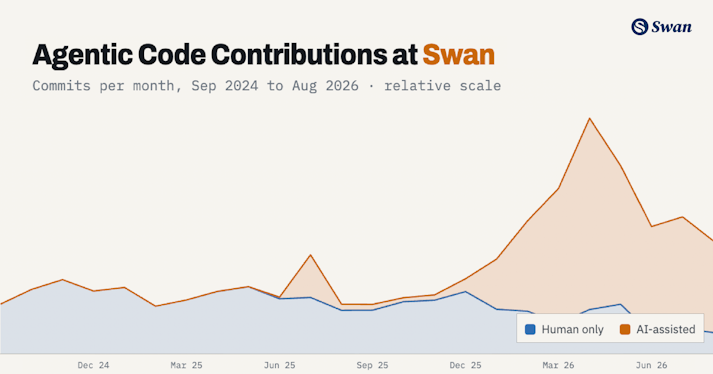
How Swan built an agentic software factory that finds production bugs, reaches consensus on the fix, opens the PR, and proves it works before a human merges.
In this article
There are 100,000,000 satoshis (sats) in one Bitcoin. A satoshi is the smallest unit of Bitcoin recorded on the blockchain: 0.00000001 BTC. With Bitcoin at about $82,900 on October 19, 2026, one sat is worth about $0.00083, so $1 buys about 1,206 sats.
At $82,918 per Bitcoin (CoinDesk, October 19, 2026):
$1 ≈ 1,206 sats
$10 ≈ 12,060 sats
$100 ≈ 120,601 sats
$1,000 ≈ 1,206,011 sats
Sats per dollar = 100,000,000 ÷ Bitcoin price.
Dollar values use $82,918 per Bitcoin (CoinDesk, October 19, 2026).
1 sat = 0.00000001 BTC ≈ $0.00083
1,000 sats = 0.00001 BTC ≈ $0.83
10,000 sats = 0.0001 BTC ≈ $8.29
100,000 sats = 0.001 BTC ≈ $82.92
1,000,000 sats = 0.01 BTC ≈ $829.18
10,000,000 sats = 0.1 BTC ≈ $8,291.81
100,000,000 sats = 1 BTC ≈ $82,918
To convert at any price: 1 sat = Bitcoin price ÷ 100,000,000. Sats per dollar = 100,000,000 ÷ Bitcoin price.
You’ll sometimes see Bitcoin amounts written in units between a sat and a whole coin:
1 bit (μBTC) = 100 sats = 0.000001 BTC. BIP-176, a 2017 Bitcoin proposal, defines 1 bit as 100 satoshis.
1 mBTC (millibitcoin) = 100,000 sats = 0.001 BTC
1 BTC = 1,000 mBTC = 1,000,000 bits = 100,000,000 sats
A satoshi is to Bitcoin what a cent is to a dollar, except much smaller. One Bitcoin divides into 100 million sats, and Bitcoin’s software counts every balance and transaction in whole satoshis. When your wallet shows 0.005 BTC, the network records 500,000 sats.
The unit is named after Satoshi Nakamoto, the pseudonymous creator of Bitcoin. The name came from the Bitcointalk forum. On November 15, 2010, user ribuck suggested that a hundredth of a Bitcoin could be called a “Satoshi.” In February 2011, ribuck proposed “satoshi” as a nickname for 1/100,000,000 of a Bitcoin, the meaning that stuck.
Bitcoin Talk Forum
Bitcoin Talk Forum
Every Bitcoin halving cuts the mining reward in half. Here is how many sats $1 bought on each halving day, using approximate halving-day prices:
November 2012 (about $12 per BTC): about 8.3 million sats
July 2016 (about $650): about 153,800 sats
May 2020 (about $8,600): about 11,600 sats
April 2024 (about $63,800): about 1,570 sats
Today, October 19, 2026 ($82,918): about 1,206 sats
In 2012, $1 bought roughly 6,900 times as many sats as it does today.
You don’t need to buy a whole Bitcoin. Most people buy in dollars and collect sats. $50 a week buys about 60,300 sats at the October 19, 2026 price.
They make small numbers readable. “5,000 sats” is easier to read than “0.00005 BTC.”
There is a fixed supply of them. Bitcoin’s 21 million coin cap means there will only ever be about 2.1 quadrillion sats, shared among everyone on Earth.
Some coins are gone for good. In 2017 Chainalysis estimated that about 2.8 to 3.8 million BTC were lost (forgotten keys, discarded hard drives), so the sats in circulation are fewer still.
Satoshi Nakamoto saw lost coins this way. In a June 2010 forum reply, he wrote: “Lost coins only make everyone else’s coins worth slightly more. Think of it as a donation to everyone.”
Bitcoin Talk Forum
Bitcoin Rich List
The Lightning Network, which makes fast, cheap Bitcoin payments, tracks balances in millisatoshis. One sat equals 1,000 millisats. The main blockchain can only record whole sats, so when a Lightning channel closes, amounts are rounded down to whole sats.
There’s no official Unicode symbol for a satoshi; the symbol for a sat is “still up for debate”. Most people write “sats” or “sat”. Bitcoiners have proposed several designs. One, from writer Arman the Parman, is a reversed “S” with a vertical stroke through it, meant to suggest “21” for 21 million. The Bitcoin sign ₿ (Unicode U+20BF, added in Unicode 10.0 in 2017) stands for whole Bitcoin.
The simplest approach is to buy a fixed dollar amount on a schedule (weekly or monthly), so you don’t have to guess the price. Then move your sats to a wallet you control.
Hold your IRA with the most trusted name in Bitcoin.
100,000,000.
About $0.00083 with Bitcoin at $82,918 (October 19, 2026). For any price, divide the Bitcoin price by 100 million.
About 1,206 at $82,918 per Bitcoin (October 19, 2026). Divide 100 million by the Bitcoin price.
About 120,601 at $82,918 per Bitcoin (October 19, 2026).
100 sats, or 0.000001 BTC, as defined in BIP-176.
About 2.1 quadrillion (2,100,000,000,000,000), because no more than 21 million Bitcoin will ever exist.
One-thousandth of a sat, used to track balances on the Lightning Network.
Drew, a class of 2013 Bitcoiner, is a Research Analyst for Swan Bitcoin.
He has worked in institutional VC/PE, FinTech, and DLT consulting for over six years. He also brings over twelve years of experience working with national nonprofits and start-ups in education and software development in several leadership roles.
In this article
Thoughts on Bitcoin from the Swan team and friends.
How Swan built an agentic software factory that finds production bugs, reaches consensus on the fix, opens the PR, and proves it works before a human merges.
Total federal debt crossed $40 trillion last week. Jeremy Showalter maps how we got here, where four institutional projections take it by 2050, and why the honest total is already about $55 trillion.
From entropy and SHA-256 to proof of work and the 21 million cap: a first principles guide to how Bitcoin works, and what you can verify yourself.