




Bitcoin Correlation With Stocks: S&P 500 & Nasdaq Data


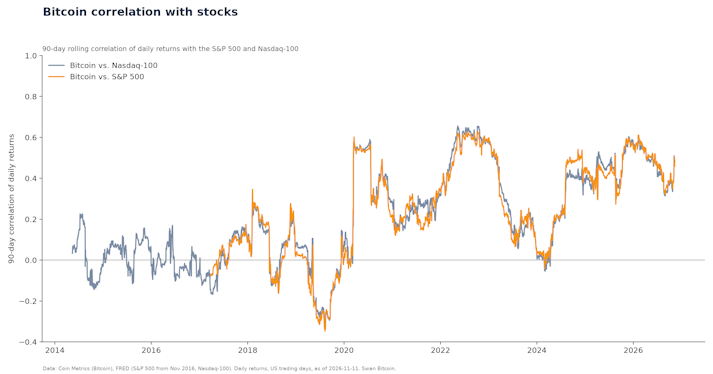
Bitcoin’s correlation with the S&P 500 was 0.42 in 2025 and 0.46 over the last 90 days (Nov 2026). Yearly data since 2017, Nasdaq, dollar and crash days.
In this article
The next Bitcoin halving will happen at block 1,050,000, which we estimate will arrive between April 9 and April 12, 2028. On November 16, 2026 the network was at block 976,146, so the halving is 73,854 blocks away. At Bitcoin’s target pace of one block every 10 minutes, that is about 513 days, or April 12, 2028. At the average pace since the 2024 halving (9.95 minutes per block, our calculation from mempool.space block times), it is April 9, 2028. On that block the mining reward drops from 3.125 BTC to 1.5625 BTC.
The date is an estimate because the halving is set by block height, not by the calendar. Blocks arrive every 10 minutes on average, but the real pace varies, so the estimate moves by a day or two as the halving gets closer. CoinWarz projects April 11, 2028 (as of November 16, 2026).
Estimated date: April 9 to 12, 2028 (estimate, as of November 16, 2026)
Block height: 1,050,000
Blocks remaining: 73,854 (block 976,146 on November 16, 2026)
Block reward: 3.125 BTC now, 1.5625 BTC after the halving
New Bitcoin per day: about 450 now, about 225 after
Halving number: the 5th of 33
Every halving so far, with the exact time each halving block was mined (UTC, from the block timestamps on mempool.space) and Bitcoin’s price on the day:
1st halving: November 28, 2012 at 15:24 UTC, block 210,000, reward 50 → 25 BTC, Bitcoin about $12, 1,425 days after the first block
2nd halving: July 9, 2016 at 16:46 UTC, block 420,000, reward 25 → 12.5 BTC, Bitcoin about $650, 1,319 days later
3rd halving: May 11, 2020 at 19:23 UTC, block 630,000, reward 12.5 → 6.25 BTC, Bitcoin about $8,600, 1,402 days later
4th halving: April 20, 2024 at 00:09 UTC, block 840,000, reward 6.25 → 3.125 BTC, Bitcoin about $63,800, 1,439 days later
5th halving (next): about April 9 to 12, 2028 (estimate), block 1,050,000, reward 3.125 → 1.5625 BTC
6th halving: about 2032 (estimate), block 1,260,000, reward 1.5625 → 0.78125 BTC
Halving-day prices are from CoinWarz (accessed November 13, 2026). Days between halvings are our calculation from the block timestamps.
The 2024 halving came at 00:09 UTC on April 20, which was the evening of April 19 in US time zones. That is why you will see both dates quoted.
Trading View
Every halving so far has arrived sooner than four years, because blocks have come faster than 10 minutes on average. Our calculation from the halving blocks' timestamps:
2012 to 2016: 9.0 minutes per block on average
2016 to 2020: 9.6 minutes
2020 to 2024: 9.9 minutes
April 2024 to November 16, 2026: 9.95 minutes
Blocks run fast when computing power is growing, because the difficulty only resets every 2,016 blocks. The gap has narrowed each cycle, so the 2028 halving should land close to the 10-minute estimate.
The halving is a rule written into Bitcoin’s code. Every 210,000 blocks, roughly every four years, the number of new Bitcoin paid to miners for each block is cut in half. It started at 50 BTC per block in 2009 and is 3.125 BTC today. “Halving” simply means cutting in half.
The halving is how Bitcoin enforces its fixed supply. No company, government or developer decides how many new coins to make. The schedule was set at launch and every node on the network enforces it. For the bigger picture, see how Bitcoin actually works.
There will be 33 halvings in total. Four have happened (2012, 2016, 2020 and 2024), so 29 are left, starting with the one in 2028.
The arithmetic: the first reward was 50 BTC, or 5 billion satoshis. Each halving cuts it in half, and Bitcoin rounds down to whole satoshis. After 32 halvings the reward is 1 satoshi; the 33rd halving, at block 6,930,000, takes it to zero. At 10 minutes per block, block 6,930,000 arrives about 132 years after Bitcoin’s first block, around the year 2140.
The reward drops to 1.5625 BTC per block on block 1,050,000. Nothing else in Bitcoin changes: no coins are taken from anyone and transactions work the same.
New supply halves from about 450 BTC a day to about 225 BTC a day (144 blocks a day).
Miners earn half as many new Bitcoin. Less efficient machines can become unprofitable and switch off. If computing power falls, the difficulty adjusts down within 2,016 blocks, so blocks keep arriving about every 10 minutes.
Transaction fees matter more to miners, because the new-coin reward is smaller.
The next halving is block 1,260,000, around 2032, when the reward drops to 0.78125 BTC.
Each halving cuts the number of new Bitcoin per day in half, and Bitcoin’s supply growth with it. Here is what that looks like, calculated from the reward schedule (144 blocks a day) and the total supply at each halving:
After 2012: 3,600 new BTC a day, supply growing about 12.5% a year
After 2016: 1,800 new BTC a day, about 4.2% a year
After 2020: 900 new BTC a day, about 1.8% a year
After 2024 (today): 450 new BTC a day, about 0.83% a year
After 2028: 225 new BTC a day, about 0.40% a year
After 2032: about 113 new BTC a day, about 0.20% a year
These are our calculations: annual new supply divided by total supply at the start of each period. Blocks often arrive a little faster than every 10 minutes, so actual issuance runs slightly higher.
Supply shock. Each halving cuts new supply in half overnight. After April 2028, only about 225 new Bitcoin will be created per day, down from about 450 today. More on supply shocks and monetary debasement.
Low and falling inflation. Bitcoin’s supply grows about 0.83% a year today and about 0.40% after 2028. Gold has no such schedule: about two-thirds of all the gold ever mined was dug up after 1950, according to the World Gold Council. See why goldbugs don’t understand money.
Pressure on miners. Miners' income in Bitcoin halves while their power bills don’t. The least efficient miners shut down, and the network’s hashrate and difficulty adjust.
Predictability. You can calculate exactly how many Bitcoin will exist on any future date. No other money works like that.
For what $1 buys in Bitcoin’s smallest unit today, see how many sats are in a Bitcoin.
Not on a fixed schedule. In each of the first three cycles, Bitcoin set a new all-time high 12 to 18 months after the halving, and the 2024 cycle peaked about 18 months after. But the 2024 cycle broke the pattern in two ways, and past performance does not guarantee the next cycle will match.
2012 halving (about $12): peaked at $1,127 on November 30, 2013, 367 days later
2016 halving (about $650): peaked at $19,665 on December 16, 2017, 525 days later
2020 halving (about $8,600): peaked at $69,044 on November 10, 2021, 548 days later
2024 halving (about $63,800): peaked around $126,000 on October 6, 2025, 534 days later
Peaks for 2013, 2017 and 2021 are from CoinGecko (updated April 17, 2026). The 2025 peak is from CryptoPotato (October 18, 2025). Days are counted from the halving date to the peak date.
What was different in 2024: Bitcoin hit an all-time high before the halving, $73,797 on March 14, 2024, driven by the new spot ETFs. And 2025 ended down 6.3% (December 31, 2024 to December 31, 2025, daily closing prices from Coin Metrics), the first down year after a halving. Bitcoin was about $64,400 on November 16, 2026 (mempool.space). Some analysts argue each halving matters less for price than the last; see the diminishing influence of halvings on Bitcoin’s price and three myths about the halving. For where analysts expect the price to go next, see our Bitcoin price prediction.
Miners' income in Bitcoin halves overnight. On each halving day, the new block reward was worth about $300 in 2012 (25 BTC at $12), about $8,100 in 2016, about $53,800 in 2020 and about $199,400 in 2024. At Bitcoin’s price of about $64,400 on November 16, 2026, the 2028 reward of 1.5625 BTC would be worth about $100,600, about half the 2024 reward, unless the price rises. These are our calculations from the halving-day prices above.
That squeeze is why mining costs matter so much. See how much it costs to mine a Bitcoin and Swan’s mining unit.
Mined so far: about 20.11 million BTC, roughly 95.8% of the total, as of block 976,146 on November 16, 2026. We calculated this from the block height and the reward schedule.
When the 2028 halving begins: 20,343,750 BTC (96.9%).
99% mined: around 2035, near block 1.41 million.
The last Bitcoin: around the year 2140, at the 33rd halving. After that, miners earn transaction fees only.
An earlier version of this article said 99% would be mined by 2032. The correct estimate is about 2035.
Miners compete to add the next block of transactions and earn the block reward plus fees.
Every node checks the block height. At each multiple of 210,000 blocks, the reward miners are allowed to claim halves.
A miner that claims more than the allowed reward gets its block rejected by the rest of the network.
Difficulty adjusts every 2,016 blocks to keep blocks about 10 minutes apart, so the schedule stays on track even as computing power changes.
The rule itself is a few lines in Bitcoin Core’s GetBlockSubsidy function: it divides the block height by 210,000 and halves the starting 50 BTC reward that many times.
We take the current block height from mempool.space, subtract it from 1,050,000, and multiply the blocks left by two paces: Bitcoin’s 10-minute target and the actual average since the 2024 halving (block 840,000 to the current block, using block timestamps). The two results give the date range. Supply figures come from the reward schedule: 210,000 blocks at 50, 25, 12.5 and 6.25 BTC, plus 3.125 BTC for each block since 840,000. We update the figures when we refresh this page; the date at the top shows when they were last checked.
The halving is a reminder that Bitcoin’s supply is fixed and gets scarcer on schedule. You don’t need to time it: many Swan clients simply buy a fixed amount every week or month and let the schedule work in the background.
Buy automatically every day, week, or month, starting with as little as $10.
At block 1,050,000, estimated for April 9 to 12, 2028 (as of November 16, 2026).
73,854 blocks as of November 16, 2026, when the network was at block 976,146.
There are 33 halvings in total and four have happened (2012, 2016, 2020, 2024). The last one is around 2140.
1.5625 BTC, down from 3.125 BTC.
About 450 today (3.125 BTC times about 144 blocks a day), falling to about 225 after the 2028 halving.
April 20, 2024 at 00:09 UTC, at block 840,000. That was the evening of April 19 in the US.
Around 2140 the block reward reaches zero and no new Bitcoin are created. Miners are then paid only by transaction fees, and the supply stays at just under 21 million.
In each past cycle Bitcoin reached a new high 12 to 18 months later, but 2025 ended down 6.3%, the first down year after a halving. Nothing guarantees the pattern repeats.
mempool.space: current block height (976,146, as of Nov 16, 2026)
mempool.space: block 840,000 and halving block timestamps (accessed Nov 13, 2026)
CoinWarz halving tracker, history and halving-day prices (accessed Nov 16, 2026)
World Gold Council: how much gold has been mined (end-Q2 2026)
CoinGecko: when Bitcoin hit all-time highs (updated Apr 17, 2026)
March 14, 2024 pre-halving high (The National) (Apr 18, 2024)
Coin Metrics: daily Bitcoin price, 2025 return (accessed Nov 13, 2026)
In this article
Thoughts on Bitcoin from the Swan team and friends.
Bitcoin’s correlation with the S&P 500 was 0.42 in 2025 and 0.46 over the last 90 days (Nov 2026). Yearly data since 2017, Nasdaq, dollar and crash days.
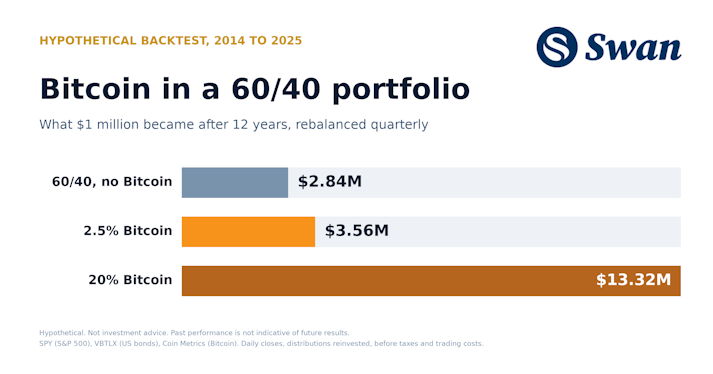
How much Bitcoin to hold in a 60/40 portfolio: 2.5% lifted annual returns from 9.1% to 11.2% (2014–2025). Results from 1% to 20%, drawdowns and method.
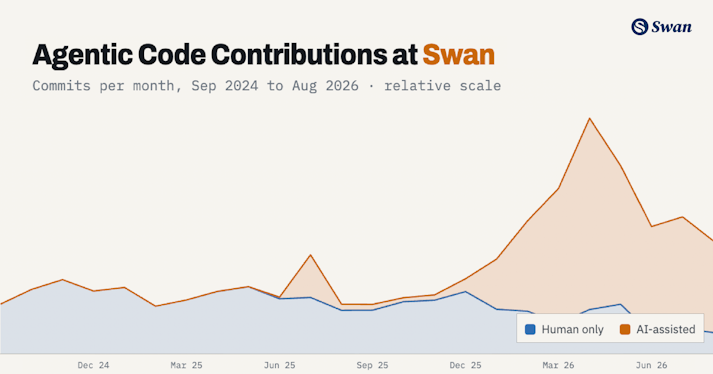
How Swan built an agentic software factory that finds production bugs, reaches consensus on the fix, opens the PR, and proves it works before a human merges.