






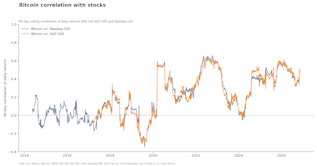
Bitcoin Correlation With Stocks: S&P 500 & Nasdaq Data


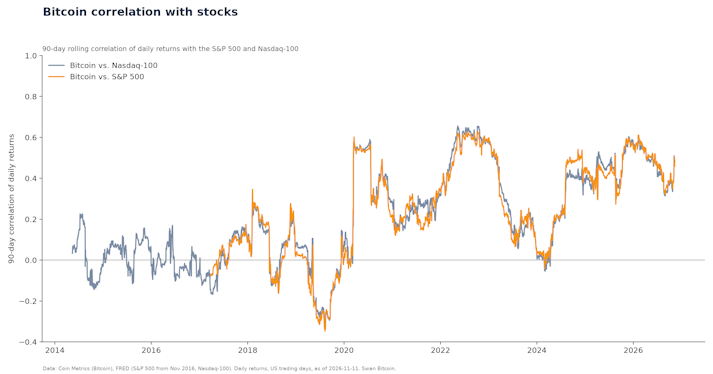
Bitcoin’s correlation with the S&P 500 was 0.42 in 2025 and 0.46 over the last 90 days (Nov 2026). Yearly data since 2017, Nasdaq, dollar and crash days.
In this article
Gresham’s law is the principle that “bad money drives out good”: when two kinds of money must be accepted at the same face value by law, people spend the one that is worth less and keep the one that is worth more. The “good” money disappears into savings, melting pots or other countries, and only the “bad” money keeps circulating. Bitcoin adds a twist, because no law fixes its exchange rate to the dollar.
This guide covers what Gresham’s law says, where it comes from, real examples from U.S. coins up to the end of the penny in 2025, its opposite (Thiers' law), and what it means for Bitcoin.
Gresham’s law says that if two forms of money circulate together and the law requires both to be accepted at the same value, the money with the lower real value (the “bad” money) stays in circulation, while the money with the higher real value (the “good” money) is hoarded, melted down or exported.
The legal tender requirement is the key condition. Economist Robert Mundell put it more precisely: bad money drives out good “if they exchange for the same price” (Wikipedia). If people are free to value the two moneys differently, the result can flip.
Commodity money has value in its own material, such as gold or silver coins.
Fiat money has no value as a material. It is money because a government declares it legal tender.
Hoarding: people keep the coins or money they believe will hold value and spend the rest.
Melting down: when a coin’s metal is worth more than its face value, coins are melted and sold for their metal.
Settling debts: debtors pay in whatever legal tender is worth the least, because the law says creditors must accept it at face value.
The result is that the weaker money does most of the circulating. People hoard gold and silver of higher purity and spend the debased coins. For more on how this feeds inflation, see the inflation-deflation tug of war.
The idea is much older than its name:
Ancient Greece: Aristophanes' play The Frogs compares bad politicians to bad coins driving out good ones.
About 1357: French scholar Nicole Oresme described the effect in his treatise on money.
1519: Nicolaus Copernicus wrote that “bad (debased) coinage drives good (un-debased) coinage out of circulation,” which is why it is sometimes called the Gresham-Copernicus law.
1558: Sir Thomas Gresham, an English financier, wrote to Queen Elizabeth I on her accession that “good and bad coin cannot circulate together.” He was explaining the state of England’s coins after the “Great Debasements” of Henry VIII and Edward VI, which cut the silver in English coins to a fraction of its earlier level (Wikipedia).
1858: British economist Henry Dunning Macleod named the principle “Gresham’s law.”
Gresham himself never used the phrase “bad money drives out good.” The name and the slogan came three centuries later.
Bitcoin Talk Forum
The Coinage Act of 1965, signed July 23, 1965, removed silver from new U.S. dimes and quarters and cut the half dollar’s silver from 90% to 40%. The new copper-nickel coins circulated next to the old 90% silver coins at the same face value. Once the Treasury stopped holding silver prices down in 1967, the silver coins were hoarded and vanished from everyday change. It is the textbook case of Gresham’s law.
What a pre-1965 quarter is worth today (our calculation): a quarter minted from 1932 to 1964 weighs 6.25 grams and is 90% silver (Wikipedia), so it holds about 0.1808 troy ounces of silver. At $52.76 an ounce, silver’s price on November 9, 2026 (Fortune), that silver is worth about $9.54, roughly 38 times the coin’s 25-cent face value. No one spends a coin like that at face value, so it left circulation, as Gresham’s law predicts.
In 1982 the U.S. switched the penny from 95% copper to copper-plated zinc (Wikipedia). The older copper cents became the “good” money: in January 2014, a pre-1982 cent held about 2.2 cents' worth of copper and zinc, so they were pulled from circulation and saved.
The newer penny eventually cost more to make than it was worth. In 2024 each one cost 3.69 cents to produce, an $85 million loss for the Treasury (FOX). The U.S. Mint struck its final circulating penny in Philadelphia on November 12, 2025, ending more than 230 years of production. Existing pennies remain legal tender (AP via TheGrio).
Gresham’s law can run in reverse. Economist Peter Bernholz named the reverse “Thiers' law,” after French politician Adolphe Thiers: when the bad money becomes nearly worthless, as in a hyperinflation, people stop accepting it, and the good money takes over (Wikipedia). Zimbabwe in 2009 is a modern example: as its currency collapsed, people turned to other currencies.
The difference comes down to choice. Gresham’s law needs a law forcing people to accept both moneys at the same value. Without that, people choose the money they trust to hold its value.
Bitcoin and the dollar circulate side by side, but no law fixes a price between them. Bitcoin’s price floats. That changes how Gresham’s law applies.
Many people already behave the way Gresham’s law describes. They treat Bitcoin as the “good” money, because its fixed supply of 21 million can’t be expanded, and the dollar as the “bad” money, because its supply can. So they spend fiat currencies and save in Bitcoin. If you are new to it, start with what Bitcoin is.
Unlike a silver coin, Bitcoin isn’t melted or physically removed. It leaves circulation by being held instead of spent.
Because Bitcoin’s price floats, the long-run question is closer to Thiers' law: if a currency keeps losing value, will merchants and savers start preferring the better money? In countries with high inflation, people already move savings out of the local currency when they can. The Cantillon effect explains who gains first when new money is created.
El Salvador made Bitcoin legal tender in 2021 and required businesses to accept it. On January 29, 2025, its Legislative Assembly voted 55 to 2 to change the law, tied to an IMF loan agreement. Bitcoin is no longer considered “currency” there, although it remains “legal tender,” accepting it is now voluntary, and it can no longer be used to pay taxes (Reason).
Gresham’s law depends on legal tender rules, so this matters. With acceptance voluntary, Salvadorans are free to value Bitcoin and dollars differently, which is the condition under which Gresham’s law stops applying.
Picture a country where Bitcoin is accepted for payment alongside the national currency. People may still spend the weaker currency first, but competition could push the system toward the stronger money:
Currency competition: governments and banks would have to compete with a money they can’t print, through better products and policy.
Financial access: anyone with an internet connection can hold and send Bitcoin, including people without a bank.
Monetary policy limits: a fixed supply limits how much a central bank can expand the money people actually choose to save in.
Merchant incentives: businesses that accept Bitcoin can avoid some payment intermediaries and pass savings on to customers.
In the other direction, governments restrict or ban Bitcoin, as anticipated in the book The Sovereign Individual:
Crackdowns: strict rules can push Bitcoin use underground without stopping it.
Capital flight: Bitcoin is a portable bearer asset, so people can move wealth across borders with it, which puts more pressure on the local currency.
Pressure on banks: banks in hostile countries could lose deposits as people protect their savings (see how Bitcoin challenges the banking system).
My Bigger Tricks
Under Gresham’s law, Bitcoin looks like “good” money: it is scarce, hard to debase and easy to carry across borders. That is exactly why it tends to be saved rather than spent. Here is the case each way.
Why Bitcoin looks like “good” money (more on Bitcoin and the problem of money):
Borderless: it works anywhere with an internet connection and isn’t tied to one country or central authority.
Secure: transactions are protected by cryptography and settled on a public network.
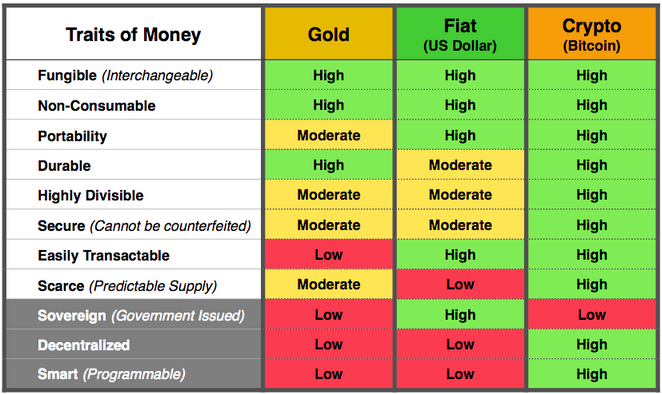
Scarce: there will only ever be 21 million Bitcoin, unlike fiat currencies that can be printed without limit. That is why it is often called digital gold.
Why some call it “bad” money:
Volatility: its price can swing widely, which makes it harder to use for everyday prices during adoption.
Limited acceptance: most shops still don’t take it.
Learning curve: wallets and private keys take some learning.
Many Bitcoiners expect volatility to fall as adoption grows, and some already choose to live on a Bitcoin standard.
Applying a law about coins to Bitcoin has limits (one overview of the debate):
No fixed exchange rate: the classic law assumes two moneys forced to trade at the same value. Bitcoin’s price floats against the dollar.
Digital, not physical: Bitcoin can’t be melted or clipped, so “driving out” means holding rather than removing.
Volatility: people who expect Bitcoin to rise are slow to spend it, while the risk-averse may avoid holding it at all.
Scaling: the base network handles a limited number of transactions. Second-layer networks help, but some argue that relying on service providers means not fully owning your Bitcoin.
Privacy: Bitcoin is not anonymous. Transactions are recorded on a public ledger and can be traced.
Gresham’s law: when the law forces two moneys to trade at the same value, people spend the weaker one and keep the stronger one.
It still happens: silver coins vanished after 1965, and pre-1982 copper pennies were saved, until the U.S. stopped making pennies in 2025.
Thiers' law is the reverse: when people are free to choose and the weak money collapses, the strong money wins.
Bitcoin: people tend to save Bitcoin and spend dollars, as Gresham’s law predicts, but because no law fixes Bitcoin’s price, its long-run path depends on which money people choose.
Join Swan Bitcoin today. Happy Bitcoin-ing!
Hold your IRA with the most trusted name in Bitcoin.
When two kinds of money must be accepted at the same face value, people spend the one that is worth less and keep the one that is worth more. “Bad money drives out good.”
The idea dates back to ancient Greece and was described by Nicole Oresme around 1357 and Nicolaus Copernicus in 1519. It is named after Sir Thomas Gresham, who wrote to Queen Elizabeth I in 1558 that “good and bad coin cannot circulate together.” Economist Henry Dunning Macleod gave it the name in 1858.
After the Coinage Act of 1965, new copper-nickel quarters circulated at the same face value as older 90% silver quarters. People kept the silver quarters and spent the new ones, so the silver coins disappeared from circulation. At November 2026 silver prices, a silver quarter’s metal is worth about 38 times its face value.
Thiers' law: when bad money becomes nearly worthless and people are free to refuse it, good money drives out bad. This happens in hyperinflations, such as Zimbabwe in 2009.
Partly. Many people spend dollars and save Bitcoin, which matches Gresham’s law. But the law assumes a fixed exchange rate between the two moneys, and Bitcoin’s price floats, so Thiers' law may describe its long-run path better.
Wikipedia, Gresham’s law (history, Mundell, Thiers' law, Zimbabwe)
Wikipedia, Thomas Gresham
Wikipedia, Coinage Act of 1965
Wikipedia, Quarter (United States coin) (6.25 g, 90% silver, 1932 to 1964)
Wikipedia, Penny (United States coin)
Fortune, Current price of silver, November 9, 2026 ($52.76 per ounce at 7:30 a.m. ET)
FOX, U.S. Mint in Philadelphia to end penny production (November 12, 2025)
Associated Press via TheGrio, US Mint presses final pennies (November 12, 2025)
Reason, El Salvador walks back its bitcoin law (February 3, 2025)
For more information, please visit swan.com.
Mickey Koss became a freelance writer in the Bitcoin space in an attempt to build a proof of work portfolio for when he left the Army. He graduated from West Point with a degree in Economics before serving in the Army for nearly a decade. He became orange pilled in graduate school and is now a regular contributor to Forbes, Bitcoin Magazine, and Bitcoin News. He’s been on popular podcasts such as BTC Sessions’ Why Are We Bullish, and is a regular on Café Bitcoin.
In this article
Thoughts on Bitcoin from the Swan team and friends.
Bitcoin’s correlation with the S&P 500 was 0.42 in 2025 and 0.46 over the last 90 days (Nov 2026). Yearly data since 2017, Nasdaq, dollar and crash days.
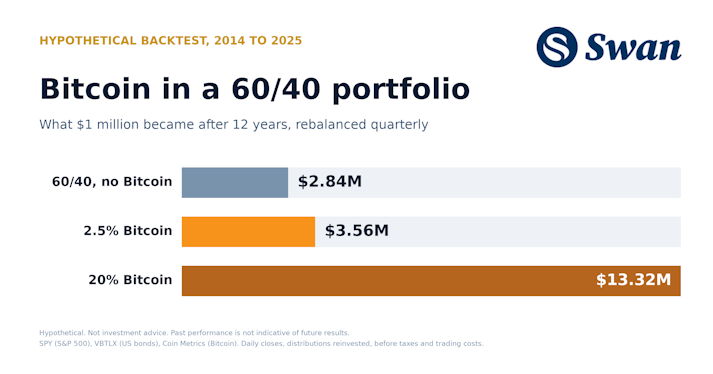
How much Bitcoin to hold in a 60/40 portfolio: 2.5% lifted annual returns from 9.1% to 11.2% (2014–2025). Results from 1% to 20%, drawdowns and method.
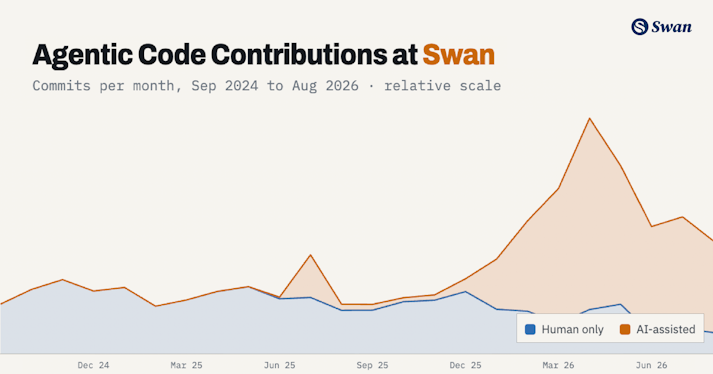
How Swan built an agentic software factory that finds production bugs, reaches consensus on the fix, opens the PR, and proves it works before a human merges.